
Crypto-Protestants in Rome
Catholicism’s Renaissance-Reformation Undercurrent

In this — Part 2 of our “deep-dive” into Roman Catholicism — we will outline a constellation of crypto-Reformers. But, first, we have two additions for our Part 1 exploration of “Curious Traditionalists.”
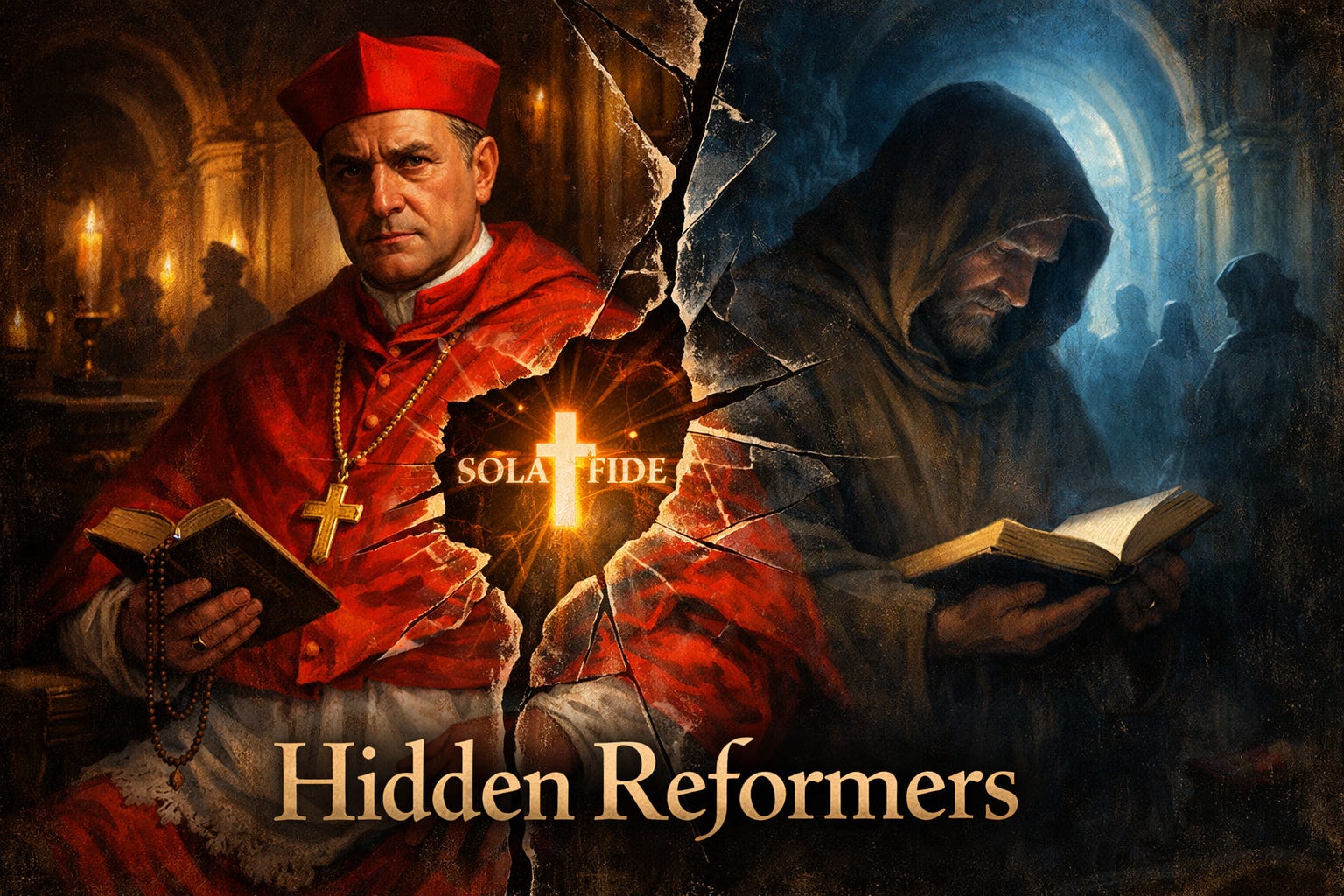
Part 1: Addenda
Buckley, William Frank, Jr.[1] (1925-2008) —
Best-remembered as William F. Buckley, Jr.,[2] he was an American author, editor, public intellectual, and TV-show host who became an influential architect of post-World-War-II so-called political “conservatism” — an ideology (technically created by Jewish-American ex-Communist activist Frank Straus Meyer) that he helped popularize.[3]
This Buckley did mainly through his magazine, the National Review (founded in 1955; see the Timeline), his long‑running television program Firing Line (first aired in 1966; cf. 1971 & 1999), and his prolific writing — all of which constituted a multi-front assault against “liberalism,” which strategy (arguably) seems to have been calculated to make an end run around the strong — and, to a large extent, bipartisan[4] — “New-Deal coalition.”
This latter had been forged by (slick advisers such as Louis McHenry Howe, for the benefit of) four-term U.S. president — and Democrat — Franklin Delano Roosevelt (“FDR”). The powerful, but tension-riddled, alliance was composed of disparate groups that were principally united by their support of FDR’s economic-relief policies. Key members of the coalition included: African Americans,[5] Irish-Americans,[6] Italian-Americans,[7] Jewish-Americans,[8] miscellaneous, further urban ethnic and immigrant groups,[9] and even Southern whites;[10] “left-leaning” intellectuals[11] — including pragmatists,[12] progressives, and “reformers”[13]; “left-leaning” religious leaders — including Catholics,[14] “Mainline” Episcopalians and Presbyterians, and “Social Gospel” proponents;[15] and, of course, labor union leaders[16] and small farmers.[17]
This coalition became such a dominant voting bloc that, had the president not died (under what some regarded as suspicious circumstances[18]), it may have gone on to even more Democratic wins than those that put FDR into the White House for an unprecedented four terms.
Consequently, Buckley’s earliest project was hyper-focused upon weakening the intellectual and electoral glue of that juggernaut. But, crafty devil that he was, he pursued this goal indirectly.
He built an ideologically disciplined and self-assured conservatism capable of scaring some of the New-Deal subgroups away from mid‑century “liberalism,” and its supposedly undesirable consequences, rather than trying to entice them to abandon FDR’s labor-oriented economic program directly. Since 1932, that sort of head-on confrontation had proved to be a monumental failure, such that Republicans — so-called “moderates,” like Dwight David Eisenhower[19] and Richard Milhaus Nixon[20] — got elected only by largely accepting the New Deal framework rather than trying to abolish it. They governed, it is sometimes said, amidst a “liberal consensus.”
And this was despite the fact that, since the mid-1930s, many “fundamentalist” Protestants — like John Franklyn “J. Frank” Norris — had been associating FDR with (if not identifying him as) the “Antichrist.” Not uncommonly, such preachers also had been claiming that the New Deal — which may (or may not) have been the outworking of an 18th-century plan, from Freemasons and the “Illuminati” — to establish a “New World Order” and usher in the end of the world.
Increasingly, these Christians generally identified Republican Party politics with Christian ethics, and dismissed Democrats as shills for Catholic “liquor interests” (Norris had also opposed Alfred Emanuel “Al” Smith in the 1928 presidential election), Freemasons (one of whom was FDR himself), and Jews (like Morgenthau). The solidification of this linkage between partisan politics and religion would occur during and immediately after the administration of 39th U.S. President James Earl “Jimmy” Carter, Jr.
Of course, “fundamentalism,” represented by Norris’s own newsletter, The Fundamentalist, took its name from The Fundamentals: A Testimony To The Truth (or “The Fundamentals”),[21] an essay collection bankrolled by Union Oil Company of California co-founder Lyman Stewart, who also helped to start the Bible Institute of Los Angeles (later renamed Biola University).
In any case, the Buckley-Meyer fusionism was a synthesis of anti‑communism, promotion of “limited government,” and a stress upon moral traditionalism. And this was partially worked out through the articulation of the so-called socio‑cultural “wedge issues.”
These included (from the Buckleyan point of view) such bugaboos as the appropriateness of “school prayer,” the inappropriateness of inner-city busing, the need to be “tough on crime,” the “un-American” nature of opposing the Vietnam War, etc. Later, opposition to other bogeyman ideas — whether real or perceived — including abortion, “critical-race theory,” “LGBTQ+” ideology, and “radical feminism,” would be added into this mix.
The common denominator, among those who aligned with Buckley’s conservatism, was the desire to peel away suburbanites, Southern voters, and white ethnics — now more expansively defined to include the Irish, Italian, and Jewish subgroups that were previously considered to be foreign — from the pluralistic New Deal. This effectively unraveled Roosevelt’s coalition and provided Republican candidates with electorally resonant “talking points” that did not require them to be overtly “anti-labor” or “pro-corporation.”[22]
Buckley, Jr. was born into a so-called “devout” Catholic family, and he maintained his personal commitment to that faith throughout his life. Indeed, he was said to have been a daily reciter of the “rosary,” a member of the Knights of Malta, and a devotee of the Traditional Latin Mass. He was on-record expressing skepticism regarding post-Vatican-II liturgical reforms. (See 1967.)
Buckley, and his National Review, will also give platforms to such other Catholics as the ex-Jesuit Fr. Malachi Martin (q.v.) and Michael Joseph “Joe” Sobran (see, e.g., 1979). The latter would eventually express his dissatisfaction with Buckleyan “fusionism” and move more towards anarcho-capitalism (as an extension of what Sobran is sometimes alleged to have termed “theo-anarchism”), or what is sometimes called “right-libertarianism.”
At the same time, in 1949, Buckley joined the occult-connected (and, frankly, sinister) fraternity of Skull and Bones while he was attending Yale University after the Second World War.[23] For reasons such as this, some critics suggest that, while Buckley may have had traditional beliefs and tastes, he was more of a “cultural Catholic” than anything else. This is to allege that Buckley likely identified with Catholicism for sentimental reasons (through ancestry, his mom’s tradition, or his overall upbringing) rather than because he strictly adhered to church authority or doctrine.
After graduating from Yale, Buckley joined the Central Intelligence Agency, where he reportedly worked out of Mexico City, Mexico under then-station-chief Everette “E.” Howard Hunt.
“Hunt,” of course, “later became notorious as one of the Watergate burglars. …After Hunt was arrested for Watergate, …Buckley, who placed a high premium on friendship and loyalty, helped pay for Hunt’s lawyers.”[24] Hunt is also a perennial candidate for having been one of the three “tramps” — either Tramp A or B, depending on the image orientation — photographed in Dallas, Texas the day of JFK’s assassination.
Incidentally, Hunt once sued the Liberty Lobby’s weekly paper, The Spotlight, for libel following its publication of an article titled “CIA to Nail Hunt in Kennedy Killing” that had been written by a former CIA agent named Victor Marchetti.[25] The article alleged that a CIA memo from 1966 identified Hunt “as one of three ‘bums’ who were arrested in Dallas the day Kennedy died”.[26]
Marchetti evidently took the line that Hunt was either being framed or was part of the conspiracy. The real “kicker” is that Hunt, who won the initial lawsuit — only to have the verdict overturned on appeal — ultimately lost the second time around.[27] Filmmaker John Hankey made a lot of hay out of the episode and concluded that, in finding Spotlight innocent of libel, the jury had essentially (and simultaneously) found Hunt guilty of being part of the JFK-assassination plot.[28]
But, back to Buckley, Jr.. Around about 1951 — when his God and Man at Yale,[29] a scathing critique of “liberalism” and “secularism” that (coincidentally and also nearly instantly) catapulted the then-25-year-old to national celebrity and public prominence — his CIA position had him situated in Mexico City. This was the same place where, around 1908, his father, William Frank Buckley, Sr., had (also coincidentally, no doubt) set up a law practice from which he (the elder Buckley) promptly got into the business of oil‑land speculation.
Within a few years, Buckley, Sr. became a major player in the so-called “Tampico oil boom,” and made a fortune acquiring leasing rights and advising U.S. and European petroleum interests.
Buckley, Sr. then founded his own oil company, called Pantepec, and gained political influence supporting the dictatorship of Victoriano Huerta — which latter, the Mexican revolutionary known as Francisco “Pancho” Villa was partially rebelling against when he was on the scene.
We got into Villa — whose real name was José Doroteo Arango Arámbula — in “10 Occultists Who Were Accused of Being Spies.” (And we have touched on Villa’s American adversary, and later World-War-I General of the Armies, John Joseph “Black Jack” Pershing, in such places as our “Haunted Washington, D.C.”)
Villa was assassinated (July 20, 1923) in Parral, Chihuahua, Mexico — killed in an ambush while driving his Dodge touring car, when gunmen hidden in a house opened fire, hitting him nine times. The attack was likely orchestrated by political rivals. Three years later, on or around February 6, 1926, Pancho Villa’s head was stolen from his grave — also in Parral. Among the prime suspects was an American soldier of fortune and spy named Emil Ludwig Holmdahl.
One story has it that Holmdahl stole the head for a $25,000 bounty. Supposedly, some time later, “…Holmdahl confessed …that he had indeed stolen the skull and later sold it to a Skull and Bones member.”[30]
The skull “became an issue in the presidential election year of 1988 when Vice-President [sic] George [H. W.] Bush, running for president of the United States, was accused of knowing its whereabouts. Bush, a Yale alumnus, was a member of that university’s Skull and Bones club which, it was said, had a collection of skulls of both the famous and infamous on display in their clubhouse.
“Also, Bush was not the first member of his family to be involved with purloined skulls. His father, Prescott Bush, a former senator from Connecticut, reputedly was involved in digging up the body of the murderous Apache raider, Geronimo, cutting off his head, and ensconcing it in the Skull and Bones club. In between pronouncements on the economy and American foreign policy, Bush denied any knowledge of …the whereabouts of Villa’s skull.”[31]
A main source for these stories was one Benjamin Franklin “Ben F.” Williams, who reported in his own autobiographical, Let the Tail Go With the Hide (privately publ., 1984), a supposed admission of the bare facts from one “Frank Brophy” — described as another Bonesman Yalie. According to Williams, Brophy confessed to him that five members of Skull and Bones raised $25,000, to be paid to Holmdahl, for the head of Pancho Villa.
A banker named Frank Cullen Brophy did, in fact, attend Yale College; the trouble with the story is that Brophy was evidently not in Skull and Bones.[32] Brophy did go on to become “one of the founders of the John Birch Society…”, and he ended up supporting the political ambitions of “…Wendell Wilkie and …Barry Goldwater…”.[33]
So, Brophy does seem to have been cut out of the same ideological cloth as the Buckleys and Bushes. Indeed, when one considers the intelligence angle, we could say something similar for Emil Holmdahl. Though, in Holmdahl’s case, we would of course have to adjust for his “lesser” socioeconomic status; he was born in Fort Dodge, Iowa, as opposed to New England (Buckley was born in New York City and Bush in a suburb of Boston).
But, for a time, Holmdahl worked under Felix A. Sommerfeld, the German head of the Mexican Secret Service. For more on Sommerfeld — and his own ties to Pancho Villa — see, again, “10 Occultist Spies.” So, given Buckley’s stint in the CIA, and the fact that “Poppy” Bush had been the DCI, post-Watergate, after the previous director William Egan Colby had seemingly allowed many (and many even “too many”) unflattering disclosures during 1975’s “Year of Intelligence.”[34]
Colby, by the way, died mysteriously in 1996. An experienced boatman, we supposedly drowned “accidentally” during a solo “canoe trip.”[35]
For our summary of George H. W. Bush’s CIA entanglements, including the possibility that none other than long-time Federal Bureau of Investigation Director — and “Commie-fighter” — John “J.” Edgar Hoover had named Bush as a CIA contact in a memo dated just a day or so after the assassination of America’s first Catholic president, John Fitzgerald Kennedy, see our “Occultist Spies” and “CIA-JFK Connexions” videos.
Moreover: “In later years Holmdahl worked for American Petroleum companies exploring for oil in Sonora, Mexico”,[36] which again places him into the same broad network as Buckley, Sr., who owned Pantepec Oil Company, and with Bush (“Sr.”), who co-founded (in 1951), with John Overbey, the Bush-Overbey Oil Development Company, which became (in 1953) Zapata Petroleum Corporation (when Hugh Liedtke came into the picture). And, of course, Bush was supposedly operating Zapata Off-Shore Company when “Operation Zapata” — the CIA’s codename for the Bay of Pigs invasion (April 1961) — failed to overthrow Fidel Castro in Cuba.
Viva Zapata! is a 1952 film by 20th Century-Fox, featuring actors Marlon Brando, Jean Peters, and Anthony Quinn. It is about the life of eventual Mexican Revolutionary Emiliano Zapata, and it focuses on his fight against then-President Porfirio Díaz over stolen peasant lands. Declared an “outlaw,” Zapata, based in the country’s south, joins up with Francisco Madero’s resistance movement to overthrow Díaz — with Pancho Villa working for similar aims in the north. Zapata remains dissatisfied even after Madero’s victory, since the latter declines or fails to deliver any of the hoped-for reform. So, Zapata continued the struggle until his assassination in 1919. For Madura’s part, he was assassination earlier, in 1913, when a U.S.-backed coup d’état (although not a major plot point) essentially put rival Victoriano Huerta into power.
And that brings us, back to Buckley, Sr. who, after the rise of Huerta’s adversary, the “socialist”-leaning strongman Álvaro Obregón, was expelled from Mexico due to his prior alignment with Huerta.[37]
So, possibly, Buckley, Jr. was an “easy sell” on the idea of taking revenge against the country that had been “disloyal” to his pops.
Going further, Buckleyite meddling may even have been more widespread. According to an article in the Executive Intelligence Review (EIR), once put out by Lyndon H. Larouche, Jr.: “The Cristero Rebellion[38] [had been] launched in Mexico to back the feudal privileges of the Jesuit-controlled, ultramontane Mexican Catholic Church in alliance with foreign oil interests. The rebellion was backed by [the senior William F.] Buckley… [and J.P.] Morgan banking interests.”[39] (On the Jesuits, see Ignatius of Loyola.) To hear Larouche tell it, Buckley, Sr. — an attorney and Rockefeller-family-connected oilman who later operated partly out of Venezuela (which country reverberates in news stories in 2026) — specifically interacted with “[René Capistrán] Garza — leader of the Jesuit-created Catholic Association of Mexican Youth (ACJM) and the National League for the Defense of Religious Liberty, which form[ed] the core of the Cristeros…”, and referred the latter “to Nicholas Brady, president of the New York Edison Company and the United Electric Light and Power Company for funding.”[40]
By the way, for later traditionalist Catholics (such as Christopher Ferrara, see 2002, 2012, and 2015), the Cristero War functions as a rhetorically powerful, modern example that crystallizes several of their core convictions at once. One is that, to them, modern secular states — even in historically Catholic societies (like Mexico) — can become aggressively anti-Christian. Secondly, that “religious neutrality” can mask coercive persecution. Thirdly, that the Church possesses rights that are “prior” to the state (along the lines of a medieval hierarchy where ecclesial law falls right underneath divine and natural law — and supersedes civil law). And, finally, that civil laws that in fact violate divine, natural, or ecclesial law are not laws at all and, therefore, may be disregarded with (moral) impunity. That the Cristero War combined anticlericalism, revolutionary nationalism, and a weak form of “socialism” made resistance to then-Mexican President Plutarco Elías Calles justifiable — even noble. Appealing to the conflict as an object lesson allows traditionalists to frame secularism (and “liberalism”), statist coercion (e.g., for socially “progressive” reforms), and anti-Christian / anti-Catholic ideology as a single, unified threat — all while holding the Cristeros aloft as martyrs (and reserving armed violence as a back-pocket option). That moneyed interests — like the Buckleys — probably leveraged the whole business mainly to resist modest land reforms and to forestall the nationalization of Mexican oil (which was, in fact, carried out by Calles’s successor, Lázaro Cárdenas, on March 18, 1938) is policed out of the historical account.
During the Cold-War period (and, indeed, at least since the Cuban Revolution in 1953), U.S. intelligence, specifically the CIA, was extensively monitoring Mexican activists, intellectuals, and media outlets. Many of these surveillance operations, including the programs codenamed LIANCHOR and LIENVOY — were conducted with the cooperation of Mexican authorities.
Presumably, something like this was what Buckley, Jr. engaged in working with Hunt.
Part of the ongoing relevance of these facts is that the U.S. is still behaving as if it is at perfect liberty to “intervene” in Mexico. As of this writing, current President Donald John Trump has made statements to the effect that drug cartels are “running Mexico” and has threatened — on that account — to use military force if the local government does not act against trafficking, specifically of fentanyl. Ironies abound, however. Not least is that, for years, it has been a bit of an inside joke that, although the U.S. Drug Enforcement Agency “runs point in the ‘War on Drugs’ …[it[ is often thwarted …by the illicitly complicit drug-underworld activities of the CIA and its ‘agents’”[41] — as the facts of Iran-Contra alone suffice to prove. During the Iran-Contra affair, U.S.-backed Nicaraguan “Contra” rebels trafficked cocaine to fund their fight against the leftist Sandinista government. There is evidence suggesting CIA contractors (such as Adler Berriman “Barry” Seal) facilitated this smuggling.[42] These activities, occurring after Congress had officially cut off funding for military intervention in Nicaragua, seems even to have involved arms and drug smuggling into the United States homeland — potentially even using military airbases.[43]
Following pressure from the Trump administration, Mexican forces (directed by U.S. intell.) assassinated the alleged leader (one Nemesio Rubén Oseguera Cervantes, nicknamed “El Mencho”) of the so-called Jalisco New Generation Cartel (“CJNG”) in early 2026.
…
Martin, Malachi Brendan (1921-1999) —
Malachi Martin was yet another curious Catholic of note. Regarded as a “staunch Traditionalist” by some, this one-time Jesuit quit the Society of Jesus (see Ignatius of Loyola) in 1964 (with permission), but (supposedly) remained a Catholic priest for the remainder of his life. (But see a summary of Michael Hoffman’s analysis, below.)
Formerly a theological expert (peritus) for the “progressive” Augustin Cardinal Bea (also a Jesuit), and an active participant in, and early proponent of, the Second Vatican Council’s “reforms,” Martin subsequently did an about-face. Thereafter, he presented himself as a critic of the post-Vatican II Church. Suddenly, he opposed the rampant liberalizing trends, advocated the restoration of traditional-Catholic practices, and aligned himself with so-called “anti-modernism.”
“Although the Periti could not take part in the [conciliar] debates themselves, they exercised an enormous influence over those debates through the advice they gave to their bishops and through their work as members of drafting committees for the various documents.”[59]
According to the late Brandeis-University, Jewish-studies Professor Edward Kvie Kaplan, Malachi Martin functioned as a literal “mole” for the American Jewish Committee (“AJC”). “…[Zachariah] Shuster [then director of the AJC’s European Office] found …ways to obtain restricted information, and even copies of secret documents. He developed a clandestine source of information, a ‘mole’ within Cardinal Bea’s Secretariat. This secret agent was an Irish Jesuit, Malachi Martin, a voluble, larger-than-life figure variously referred to as ‘Forest,’ ‘Pushkin,’ and Heschel’s ‘young friend’ in Shuster’s confidential reports and transcripts of transatlantic phone conversations. Martin, a highly educated Old Testament scholar at the Pontifical Institute in Rome, was sympathetic to the Jewish position. He held degrees in ancient Semitic languages and biblical archeology from the University of Louvain [in Belgium] and had studied at Oxford [in the U.K.] and the Hebrew University in Jerusalem [in Israel]. Martin also knew modern Hebrew, Arabic, and several European tongues.”[60]
“Cardinal Bea’s Secretariat,” or the Secretariat for Promoting Christian Unity, was a one of the preparatory commissions established by Pope John XXIII to lay groundwork for the Second Vatican Council. Established June 5, 1960, and led by German Jesuit Cardinal Augustin Bea, this particular group spearheaded the Catholic Church’s “ecumenical” efforts. Specifically, Bea was tasked with encouraging interfaith “dialogue,” not only with other Christian denominations (such as Eastern Orthodoxy and Protestantism), but also the Jewish people and Judaism.
Presumably in his capacity as a double-agent, and while Vatican II was going on, Martin leaked two letters that had been written by Pericle Cardinal Felici, and which had been intended to remain private, internal-Curial communications. The upshot was that Felici was “warning” his fellow cardinals that an emerging conciliar “schema” — concerning the Church’s relationships with non‑Christians, in general, and Jews, in particular — had potential doctrinal pitfalls.
But Martin passed these letters along to the press, ostensibly to expose “conservative” resistance to liberal Cardinal Bea’s reformist ambitions. Excerpts appeared in the New York Times.[61] The significance of the episode — which both helped shape public perception of Vatican II’s debates on Judaism and and pressured the Council itself to eventually approve Nostra Ætate — lies in its exposure of a fierce internal struggle between, on the one hand, Bea’s progressive “Secretariat” and, on the other, the “conservative” Curial faction (including Alfredo Cardinal Ottaviani and Archbishop Marcel Lefebvre).
Going further, under the pseudonym “Michael Serafian,” and in 1964 (before Vatican II formally ended), Martin published The Pilgrim: Pope Paul VI, the Council, and the Church in a Time of Decision.[62] In it, Martin basically represented Paul VI as a well-intentioned, “reform-minded,” “pilgrim of the spirit,” who tried to follow through with John XXIII’s vision, but who was inept at navigating the Second Vatican Council’s increasingly volatile landscape.
According to Martin, “conservatives” inside the curia began to constrain Paul VI, who then not only lost momentum, but who also became overshadowed by institutional forces. This led to the palpable tension between doctrinal and “pastoral” that has plagued analyses and summaries of Vatican II ever since. (See, also, Joe Sobran’s similar comments in the Timeline: 1979.)
Martin’s The Pilgrim identified the council as a crossroads for the Church, and suggested that its outcome would determine whether Catholicism would embrace genuine renewal and, moreover, whether it could confront its historical failures — including, principally — its alleged complicity in “paving the road to Auschwitz.”
Kaplan went on: “In mid-March, [1964, Rabbi Abraham Joshua] Heschel arranged with Roger Straus [co-founder of the Farrar, Straus and Giroux imprint] for Malachi Martin, who was now at the Biblical Institute in Jerusalem, to publish his ‘kiss and tell’ book about the internal workings of the Ecumenical Council in the hope that it would influence the present deliberations. In May, Farrar, Straus published The Pilgrim (referring to Pope Paul VI) under the pseudonym of ‘Michael Serafian.’ With a treacherous blend of fact, overstatement, and invention, it characterized the pope in unflattering but essentially accurate terms as sincere and intelligent but indecisive, weak, and beholden to the Curia. Martin’s identity was soon uncovered, and many protested his betrayal. The book was removed from circulation, at considerable financial loss to the publisher. Heschel and Roger Straus eventually ended their friendship with Martin.”[63]
Kaplan’s assertion that Roger Strauss “ended [his] friendship with Martin” is perplexing, since the former was a member of the wealthy Guggenheim family, and Malachi Martin received two Guggenheim Fellowships subsequent to his dealings with Farrar, Straus and Giroux — the first fellowship in 1967, followed by a second in 1969.[64]
The story goes that, after Martin resigned from the “Jebbies” (Jesuits), it was Guggenheim money that allowed him to go from odd jobs (like taxi driving) to full-time writing in New York.
In 1966 (see the Timeline), a year after Pope Paul VI closed the Second Vatican Council, Look magazine “senior editor” Joseph Roddy published his article “How the Jews Changed Catholic Thinking.”[65] In the piece, which Kaplan described as “[a] dangerously misleading article[,] … Roddy …gave credence to the claim that without pressure from the Jews, the declaration would not have been accepted. He also reported, conversely, that the presence of Jewish lobbyists in Rome had invigorated the declaration’s conservative opponents. The article revealed secret information (much of it obtained from Malachi Martin, who was given the pseudonym ‘Fitzharris O’Boyle’), along with numerous errors of fact and egregious distortions.”[66]
Thus, as Wikipedia accurately summarizes, Roddy had disclosed that “one and the same person [i.e., Martin] under three different pseudonyms [i.e., F.E. Cartus, Fitzharris O’Boyle, and Michael Serafian] had written or acted on behalf of Jewish interest groups, such as the American Jewish Committee, to influence the outcome of the debates.”
Just for additional context, Look magazine was printed by American publishing magnate John Cowles, Sr., co-owner — with his brother Gardner Cowles, Jr.[67] — of the parent corporation, Cowles Media Company.
During the middle of the 1960s, and “[t]o help counteract the agitation against the Vietnam War”,[68] John coordinated with such other Establishment Insiders as Dean Gooderham Acheson; Eugene Robert Black; James Bryant Conant; Arthur Hobson Dean; Thomas Sovereign Gates, Jr.; Roswell Leavitt Gilpatric; John Jay McCloy; and David Rockefeller.[69]
For his part, brother Gardner, Jr., who had been a part of the U.S.’s World-War-II-era propaganda Office of War Information, was supposedly an executive with the CIA front known as the “Farfield Foundation.”[70] Gardner’s Wiki asserts that “[h]e was a delegate to the 1954 Bilderberg Conference, the first meeting of the conference.”[71] Additionally, and until his death in 1964, “former” Office of War Information U.S. Army psychological-warfare operative and speechwriter for Dwight D. Eisenhower, Charles Douglas “C. D.” Jackson, was a senior executive of Time Inc. where, among other things, he arranged the purchase (and immediate concealment) of Abraham Zapruder’s eponymous film that had captured video of John F. Kennedy’s assassination. (Cf. Spruille Braden in Final Remarks.)
Martin was a busy bee — mainly distributing (what his critics describe as) falsifications. For example, consider the comments of 20th-c. Catholic theologian Monsignor John Maria Oesterreicher,[72] a prominent proponent of “Jewish-Catholic reconciliation” and one of the authors of the controversial 1965 Vatican-II declaration Nostra Ætate, or “In Our Age,” which “recharacterized” the Church’s relationship vis-à-vis Judaism, condemned “antisemitism,” etc.
According to Msgr. Oesterreicher, Martin had been — almost singlehandedly — responsible for some of “[t]he most alarming examples of ‘disclosures’ which, for want of better information, [were at the time] accepted by many as authentic reports,” including: “…The Pilgrim by M. Serafian, and an article on the history of the Declaration on the Jews, entitled ‘Vatican II and the Jews’ ([the American Jewish Committee’s magazine,] Commentary,[73] January, 1965) by the same author. He is an ex-Jesuit, Malachi Martin, this time using another pseudonym, F. E. Cartus. The article contains a prayer ascribed to Pope John [XXIII] that has had wide currency, though everyone who knew the Pope’s mind and style is convinced that it was fabricated. Moreover, Mr. Martin has in all these years refused to offer any proof of the prayer’s authenticity, a photocopy of the original, for instance. Nor did he ever reveal how he came into the possession [sic] of the alleged prayer of Pope John.”[74]
Oesterreicher has the text of the supposed “Prayer for the Jews,” ostensibly addressed to Jesus, reading, in part: “Forgive us [i.e., Christians] for the curse we falsely attached to their name as Jews. Forgive us for crucifying You a second time in their flesh. For we knew not what we did. …We bear the mark of Cain on our brows, …our brother Abel has lain in the blood we have shed… Forgive us for crucifying You a second time.”[75]
In the decade following the council, Martin became a correspondent and columnist for William F. Buckley Jr.’s (q.v.) National Review, for which he served variously as the “religious editor” and as frequent contributor. Martin was presented by Buckley as a “Vatican insider” with a deep understanding of conciliar and curial affairs. His contributions purported to analyze Rome’s — and Vatican II’s — policies, mainly in terms of alleged “communist appeasement.” Martin’s star rose even higher when Buckley interviewed him on the former’s PBS program Firing Line.
Basically, Martin gained a reputation accusing the Catholic hierarchy of themselves being — or, at least, allowing the Church to be “infiltratrated” by — “modernists” as well as, by extension, supposedly abandoning “traditional doctrine.”
But, Martin went beyond even this and positioned himself as an experienced “exorcist” who was a first-hand witness to literal “Satanic rituals” occurring inside the Vatican itself. Though, Martin would never specifically say who or where.
Independent-film producer Rachel Lysaght, who researched Martin for the 2017 Netflix video Hostage to the Devil,[76] said of her subject: “William Peter Blatty (author of the original Exorcist novel) wrote a tirade against Malachi, saying his 1976 book was fantasy, and he was just trying to cash in.”[77]
In the view of contrarian, Fortean writer, and independent historian Michael A. Hoffman II, the popular image of Malachi Martin as a fearless insider exposing corruption in the post-Vatican-II Church is largely a fabrication. Hoffman argues that Martin was, in fact, deeply implicated in the very conciliar reforms he later claimed to oppose.[78]
Hoffman reminds that, during the council itself, Martin served as a theological “expert” (peritus) to Cardinal Bea and actively participated in the milieu that produced documents such as Nostra Ætate. For Hoffman, then, Martin’s later reinvention as a “traditionalist” critic of the post-Vatican “liberalization” of the Church represents not a genuine conversion but a strategic reversal — possibly in his capacity as a literal Jesuit intelligence operative — one that allowed him to posture as a prophet of the crisis while obscuring his earlier rôle in helping to create it.
Hoffman further contends that Martin functioned less as a “whistleblower” than as a gatekeeper for the post-conciliar establishment. In Martin’s telling, the papacy — whether under Paul VI or John Paul II — remains fundamentally orthodox (that is, “right-thinking”) Catholic. Corruption is attributed to shadowy factions, rogue clerics, or even occult infiltrators.
This narrative, Hoffman suggests, conveniently and deliberately shields the institutional Church hierarchy from accountability for its complicity. At the same time, Hoffman faults Martin for promoting sensational (New-Age and occultic) claims — for example, about: his (i.e., Martin’s) own sketchy and supposed psychic perceptions, demonic conspiracies within the Vatican, and unhinged apocalyptic conjecture.[79] And this Martin did even as he also advanced theological positions that Hoffman regards as both dubious, syncretistic, and — in a word — un-Christian.[80]
The result, in Hoffman’s considered opinion, is a contradictory figure: a man presenting himself as a “defender of Catholic orthodoxy” while simultaneously trafficking in speculation, unverifiable stories, and doctrinal ambiguities that ultimately render him an unreliable guide to the very crisis he purported to expose. And Hoffman thought that Martin himself either subtly disclosed these facts — or let them slip — in virtue of the latter’s comparison of himself to the 12th-century Spanish-Jewish Talmudist Moses ben Maimon (or the Rambam), best known as “Maimonides.” To Hoffman, this was either a signal to occultic or Talmudic initiates that Martin was “their kind of guy”; or else it was pretty straightforward evidence that Martin was ignorant of the very esoteric matters in which he claimed expertise.[81]
Adding yet another layer to the controversy, Hoffman later assembled[82] what he described as a “dossier,” portraying Martin, not merely a contradictory public figure, but also as a deeply compromised one. According to Hoffman (and other critics he cites), Martin’s later persona as a Catholic priest, exorcist, and defender of orthodoxy itself rested on shaky ground. Hoffman (et al.) alleges that Martin had in fact been effectively laicized after leaving the Jesuits — despite continuing to present himself publicly as a priest.
Likewise, Hoffman disputes Martin’s reputation as a seasoned exorcist, and points to statements from clergy in New York that suggest Martin never participated in officially sanctioned exorcisms there at all. Hoffman’s compilation also repeats accusations of personal scandals — including alleged romantic relationships with married women — and highlights controversial remarks attributed to Martin in interviews touching on speculative theology and paranormal phenomena.
Taken together, Hoffman marshaled these claims to argue that Martin was neither the reliable “Insider” nor the stalwart traditionalist that many admirers believed him to be. Instead, Martin was a sensationalist whose shifting roles — Vatican-II collaborator, journalist-spy, fake exorcist, and faux-prophet of the modern Church — reflect a pattern of contradiction that, in Hoffman’s view, totally undermines Martin’s credibility.
…
Part 2: Curious Proto-Protestant Catholics
On Martin Luther
Of course, nearly everyone has heard of or read about the world-historic German theologian Martin Luther (1483-1546). He began his religious life as a Catholic Augustinian friar, under the headship of people such as Giles of Viterbo, but ended it as the seminal Protestant Reformer.
According to historian Eric Leland Saak, Martin Luther’s “early theological development was conditioned by the Franciscan tradition (e.g., Ockham) more than by the Augustinian, even as he eagerly studied the works of Augustine himself.”[113]
It’s worth noting that, even insofar as his explicit Augustinian influences are concerned, Luther’s early theological orientation seems to have had a decidedly slant toward Gnostic dualism or Manichæanism, according to some analyses.
Evidence for this can be found in Luther’s handwritten glosses and marginalia, particularly those attached to his copy of Augustine’s famed Confessions.
“…Luther …scorned Augustine, who had written so eloquently against the Manichaeans of his own day. In Confessions, for example, where Augustine criticizes the concept of two divinities struggling with each other, Luther writes in the margin, ‘This is false. This is the origin of all Augustine’s errors.’ Luther attacks Augustine for attacking Manichaeism; this is why [Philipp] Melanchthon in turn accused Luther of Manichaean delirium, precisely because the concept of two gods, of two Christs, emerges in Luther.”[114]
One contemporary, conservative Roman Catholic critic goes so far as to opine: “It is appalling that Luther has been viewed as some sort of Augustinian. He despised Augustine and thought his work was riddled with errors. Luther sides with the Manichaeans over Augustine.”[115]
When Luther left the Augustinians, several others immediately followed suit, such as Gabriel Zwilling (a.k.a., Gabriel Didymus). These departures were especially common in Saxony, where Luther’s influence was evidently strong, owing partially to the early support of Elector Frederick III of Saxony (“Frederick the Wise”), who shielded Luther. Frederick first staged a sham “kidnapping” of Luther, who subsequently holed up in Wartburg Castle under the false identity “Junker Jörg” (“Knight George”).
Thereafter, Luther was able to translate the New Testament into German in relative safety and quiet. As it happened, this was in partial fulfillment of hopes of Venetian, Camaldolese monks Paolo Giustiniani and Pietro Quirini, who were in the circle of the curious Cardinal Gesparo Contarini. Contarini, in turn ran a group of reform-friendly prelates (including English Cardinal Reginald Pole) from within the Vatican itself.
Indeed, it is arguable[116] that — with respect to the articulation of the doctrine of sola fide — Cardinal Contarini may have beaten Luther to the punch by several years.[117] It’s by no means obvious, however, that the former somehow communicated this to the latter. After all, Luther (in)famously seemed to have declared that he had his “thunderous” awakening while on the toilet.[118] And, presumably, Contarini was not present in that men’s room.
Nevertheless, despite the uncertainty (of course, we may never know the truth of any of these matters, this side of eternity, at any rate) there are more than a few other curious individuals to take notice of — on the “Catholic side” — in the prehistory and early history of Protestantism.
Agrippa, Heinrich Cornelius (1486-1535) —
German Renaissance occultist, polymath, soldier, and spy, best known for his three-volume De occulta philosophia (“Of Occult Philosophy”).[119] Like the famed medical innovator Paracelsus, Agrippa was influenced or trained by the Benedictine monk and magus Johannes Trithemius. Like his mentor, Agrippa has had a lasting reputation as a “black magician.” Tales of his alleged exploits — including his association with a familiar spirit in the form of a black dog (or schwarzer pudel) — informed the legend of Doctor Faustus.
At one point in his storied career, “…Agrippa …appear[ed] in the northern city of Metz where the growing influence of [German Reformer Martin] Luther was causing turmoil. … Agrippa … moved from …Renaissance Italy …on the eve of Reformation. Agrippa and his friends closely followed the writings of Luther. Some of these friends afterwards became Lutheran Protestants.
“From Metz, Agrippa moved to [John Calvin’s stronghold of] Geneva where he had occultist friends. Some historians of the origins of Protestantism in Geneva have regarded Agrippa and his circle of the early 1520s ‘as the seed-bed of the reformed faith’.”[120]
Note that, although it sometimes designates the entirety of the Protestant “Reformation,” here, the word “reformed” refers specifically to the teachings of John Calvin and his successors.[121]
Alcaraz, Pedro Ruiz de —
See Alumbrados.
Alumbrados (15th-16th c.) —
Co-founded as early as 1511 by Mexican-born Pedro Ruiz de Alcaraz (himself born into a family of conversos[122]), the Alumbrados — sometimes translated as “Enlightened Ones,” “Illumined Ones,” or even “Illuminati” — were a Spanish mystical movement whose followers claimed direct inner illumination from God. In short, Alumbrados was “the rather vague label attached in Spain to a variety of sects …often with quite different beliefs …that emphasized mystical union with God rather than traditional prayer and the sacraments.”[123]
At the same time, they rejected many trappings of prevailing forms of religion (such as the need for priestly mediation and Catholic sacraments). Additionally, and similarly to certain varieties of Gnosticism, such as Carpocratianism (which we surveyed in “10 ‘Sex-Magic’ Cults”), some Alumbrados evidently held that “[c]arnal desires may be indulged and other sinful actions committed freely without staining the soul.”[124] One source suggests that “[d]uring their meetings some of the younger women became subject to curious seizures. Some broke out in sweat and fainted, some vomited, and some writhed on the ground, claiming to have visions of the devil.”[125]
The church took a dim view of these tendencies; consequently, Alumbrados were targeted as heretics by the dreaded Spanish Inquisition. Indeed, according to the Catholic Encyclopedia: “So rapidly did the errors gain ground that the Inquisition proceeded with relentless energy against all suspects, even citing before its tribunal St. John of Avila and St. Ignatius of Loyola [q.v.].”[126]
In place of then-traditional ritualism, the Alumbrados advocated dexamiento, that is, (something like) “abandonment” or “surrender” of the individual (soul) to the love of God. As such, their approach could be considered a Spanish extension or variant of the earlier Devotio Moderna (“Modern Devotion”) movement, which originated in the Netherlands and influenced such people as Desiderius Erasmus of Rotterdam.[127]
Both the Devotio Moderna and the Alumbrados emphasized personal or private piety and a form of religious devotion centered on experience, interiority, and simplicity. The Spanish variant was also energized by the writings of diverse thinkers such as: the late-5th to early-6th-century Procline Neoplatonist Pseudo-Dionysius the Areopagite; the 12th-century Catholic Benedictine reformer, Cistercian Order founder, and Knights Templar co-founder St. Bernard of Clairvaux; the 13th-century Augustinian-Franciscan theologian St. Bonaventure; the 13th-14-century Jewish-Aristotelian rabbi, Talmudist, and reformer Levi ben Gershom (“Gersonides”); and the 15th-century German-Dutch Augustinian canon and mystic Thomas à Kempis.
Supposedly funded by Portuguese nobleman Diego López Pacheco (Diogo Lopes Pacheco), Pedro Ruiz de Alcaraz supposedly started makeshift “catachism” classes that transmitted his perspectives to people such as Juan de Valdés.
“…[T]he heresy maintained itself until the middle of the seventeenth century and some of its features reappear in the Quietism of the Spaniards Michael de Molinos.”[128] Others, going even further than this, assert that the Alumbrados were the “forerunners of the Rosicrucians and the [Bavarian] Illuminati…”.[129]
Bascio, Matteo da (1495-1552) —
Born Matteo Serafini, he was the principal founder, in 1525, of the Order of Friars Minor Capuchin,[130] a “reform branch” of the better-known Franciscans that, in turn, had been created three hundred years earlier (1209) by St. Francis of Assisi. The context of da Bascio’s curiously timed appearance on the scene, circa the 1520s, is that numerous other ostensibly Catholic proto-Protestants (like Gesparo Contarini) were operating alongside the seminal and so-called “Magisterial Reformers”[131] (such as John Calvin, Thomas Cranmer, Martin Luther, Huldrych Zwingli; see, e.g., On Martin Luther), all to bring about changes within the Catholic Church.
Da Bascio’s stated rationale behind the formation of the Capuchins was that St. Francis’s ideals of humility and poverty had been variously abandoned altogether by some work-a-day friars, or else had been relaxed through casuistry and legal loopholes. An example of this might be that, whereas an individual friar isn’t permitted to own much (if anything) on his own (i.e., privately), friars living together could say that the property was owned by the group (i.e., communally).
Da Bascio wasn’t the only person upset by these developments. Indeed, on June 12, 1517, Pope Leo X — born Giovanni di Lorenzo de’ Medici — split the Franciscan Order in half, with the “Conventuals,” or, those who lived together in a their own small communities (“convents”), authorized (in the bull Omnipotens Deus, “Almighty God”) to operate separately from what were now being called the “Observants,” or those Franciscans who interpreted “poverty” more strictly.
For his part, da Bascio didn’t think that the Observants were radical enough and sought permission to create a third subgroup within the Franciscans that would be dedicated to the austerity, primitivism, and simplicity that (he believed) St. Francis of Assisi had intended.
Thus, the Conventuals[132] — now otherwise known as “Greyfriars” because of the color of their attire — enjoy “dispensations” that allow for property ownership and often engage in academic study, which was frowned upon by the order’s founder. Observants[133] and Capuchins[134] both wear brown, but the latter are often visually distinguishable by their pointy hoods (called, in Latin, a capuche, or a cappuccio, in Italian) and beards.
Notwithstanding all the fuss over renunciation of money and possessions, da Bascio was evidently backed — directly or indirectly — by Italian Duchess Caterina Cybo (1501-1557), granddaughter of Florentine major domo Lorenzo de Medici.[135] At the least, Cybo provided diplomatic cover for the Capuchin founder, “mediati[ng]” with “Pope Clement VII” — born Giulio di Giuliano de’ Medici — who promptly gave his blessing via the bull Religionis zelus (“Religious Zeal,” Jul. 3, 1528), after which da Bascio was permitted “to live as a hermit,” went abroad “preaching to the poor,”[136] and eventually became the Capuchin’s first Superior-General.
A fascinating — though inadequately cited — chapter in da Bascio’s life is hinted at in his Wikipedia article. According to it, in between an allegedly secret permission granted to the Capuchins by Leo X, and its ultimate, overt recognition by Clement VII — both Medici popes, as noted already — “Serafini [i.e., da Boscia] and his first companions were forced into hiding from church authorities, who sought to arrest them for having abandoned their religious duties. They were given refuge by the Camaldolese monks, in gratitude for which they later adopted the hood (or cappuccio) worn by that Order — which was the mark of a hermit in that region of Italy — and the practice of wearing a beard.”[137]
For more on the Camaldolese, who were, at the time, going through their own internally driven “reformation,” see Paolo Giustiniani and Pietro Quirini.
Beneficio di Cristo (“Benefit of Christ”) —
This devotional text, the full title of which is Trattato Utilissimo del Beneficio di Iesu Cristo Crocifisso (“A Most Useful Treatise on the Benefit of Jesus Christ Crucified”), was originally composed (circa 1537-1543) by a Benedictine monk named Benedetto Fontanini[138] (a.k.a. Benedetto of Mandova), possibly at the monastery of San Nicolò l’Arena in Sicily.
If this is true, it would be a coincidence of the Nick-Name phenomenon and Mystery Méditerr.
At least one of Benedetto’s associates and fellow Benedictines, Francesco Negri (a.k.a. Francesco Buonamonte), became a Protestant in 1525.
Benedetto’s book was later expanded and reworked (by one Marcantonio Flaminio, a disciple of Juan de Valdés and Cardinal Reginald Pole) to be a vehicle for mystical-Valdesian theology.
In any event, the Beneficio popularized the doctrine of “salvation by faith alone” — best known as the “material principle” of the Protestant Reformation,[139] but in fact first articulated by the supposedly Catholic Cardinal Gesparo Contarini and his band of Spirituali (including Pole).
Nevertheless, the edited book owed much to French-born reformer John Calvin’s “Institutes of the Christian Religion”[140] and is, thus, considered to be within a broadly Augustinian tradition. However, for a few wrinkles, see the footnotes under the section for Martin Luther.
The Beneficio was naturally registered on the Index Librorum Prohibitorum (“Index of Forbidden Books”) and was a target of the Roman Inquisition, just as the followers of Valdés were targeted by the more notorious Spanish Inquisition.
Contarini, Gasparo (1483-1542) —
Venetian-Italian diplomat and Roman Catholic cardinal-bishop of the Diocese of Belluno.
In 1511, Contarini corresponded with friends and acquaintances in a Tuscan Camaldolese monastery near Arezzo, Italy. “Contarini’s letters reveal …that he was preoccupied …with problems very similar to those which [Martin] Luther was experiencing in Germany: and that after an early crisis, he resolved them in a manner not dissimilar to that which Luther independently adopted. Contarini’s crisis, like that of Luther, revolved around the problem of salvation, and the necessary means to its attainment. …Contarini [experienced] …the same advance from fear to confidence, from helplessness to absolute assurance, which characterised the experience of Luther. …His own works were powerless to assist him: confidence in Christ was everything.”[141] “The parallels to Luther are evident, even though Contarini still allows hope and a little love a role in salvation, in addition to faith.”[142]
Following this, Contarini was reportedly an observer — if not a participant — in the 1521 Diet of Worms. Called by Holy Roman Emperor Charles V, this assembly was conducted in the city of Worms. Its aim was to compel Luther “off the fence,” either to affirm or renounce his contrarian views in response to Pope Leo X’s papal bull. Ultimately, of course, Luther chose the former, after which Charles V formally branded the seminal reformer a “notorious heretic” and in his condemnatory Edict of Worms.
“Later, in a letter of 1523, after Contarini had seen Luther, he would go beyond this and wholly embrace the Lutheran position…[, writing]: … ‘…no one can justify himself with his works or purge his soul of its inclinations, but …it is necessary to have recourse to divine grace which is obtained through faith in Jesus Christ… [E]very living man is a thing of utter vanity, and that we must justify ourselves through the righteousness of another, and that means of Christ: and when we join ourselves to him, his righteousness is made ours’ …”[143]
“These letters, first published in 1950, [arguably] make Contarini the first Protestant.”[144] After all, the Catholic cardinal effectively argued for a version of what became known as “salvation by faith alone” (sola fide). Furthermore, Contarini actively promoted the same “evangelicalism” in a group of “crypto-Protestants” known as di spirituali.[145] Among his collaborators were the English Cardinal Reginald Pole (1500-1558), the last Catholic Archbishop of Canterbury; Italian noblewoman and poet Vittoria Colonna (1492-1547); Vittoria’s friend, the famed Renaissance artist Michelangelo di Lodovico Buonarroti Simoni (1475-1564), and Italian Cardinal Jacopo Sadoleto (1477-1547). With Pole and Sadoleto, Contarini presided over the Consilium de Emendanda Ecclesia, a 1536 commission, authorized by Pope Paul III, that catalogued “abuses” within the Catholic Church.[146]
At the same time, Contarini was also a major sponsor of the Jesuit religious order, the spear tip of the Catholic counter-reformation. Wikipedia goes so far as to say: “Ignatius [of] Loyola acknowledged that Cardinal Contarini was largely responsible for the papal approbation of the Society of Jesus, on September 27, 1540.”[147]
Giles of Viterbo (1469/1472-1532) a.k.a. Ægidius Viterbensis, Giles Antonini —
This Augustinian friar, and later cardinal, was — along with people such as Gesparo Contarini and Erasmus — yet another “reform”-minded cleric within the Roman Catholic Church. Among other things, Giles is fondly remembered by Jewish historians as the patron of Elia Levita. Levita was a Jewish scholar and mystic who not only taught the cardinal to read Aramaic and Hebrew, but also, under the latter’s protection, is said to have instructed various Christian intellectuals in the “Hebrew Bible” (i.e., the Tanakh[148]) and language, Jewish folklore, Kabbalah (as integrated into “Christian Cabala”), rabbinical literature, and so on. Levita’s important Hebrew grammar, the Baḥur (“Student,” 1518) opens with a dedication to Giles. The cardinal, in turn, either taught Levita the “classics” and Greek, or else arranged for him to receive instruction.
Michael Hoffman gets into both figures — Giles of Viterbo and Elia (Elias) Levita. (See Hoffman, Michael, The Occult Renaissance Church of Rome.)
As head, or prior/vicar general, of the Order of Saint Augustine (1506–1518/1519), Giles was apparently interested in realigning the Augustinians with Renaissance humanism. He would certainly have been in charge of then-future, seminal Protestant “Reformer” Martin Luther. Indeed, Luther likely had direct dealings with Giles, since the guy was his highest ecclesiastical superior during many of the years of the former’s monastic life. A face-to-face meeting may have occurred when Luther visited Rome around 1510-1511. Despite the imminent defection of Martin Luther and several other friars — not to mention the rupturing of Christendom — under his watch, Giles was made Cardinal Ægidius of Viterbo in 1517 by Pope Leo X (Giovanni di Lorenzo de’Medici).
Sometime, thereafter, he wrote Informatio pro sedis apostolicae auctoritate contra Lutheranam sectam (“Information for the Authority of the Apostolic See Against the Lutheran Sect”).
Reportedly, Ægidius (“Aegidius”), derived from the Latin ægis (shield), translates to “protector.”
Giustiniani, Paolo (Tommaso) (1476-1528) and Pietro (Vincenzo) Quirini (1478-1514) —
Venetian-Italian nobility who “both joined” — and reformed — “the Camaldolese branch of the [Catholic] Benedictine [religious] order in 1511.”[149] As synchronicity would have it, Giustiniani established his own branch, now known as the “Camaldolese Hermits of Mount Corona.”[150]
Friends of Pope Leo X (Giovanni di Lorenzo de’ Medici), they wrote the Libellus ad Leonem X (“A Pamphlet to Leo X”) in 1513.[151] The document is routinely regarded as a bold entreaty for the institution of broad and comprehensive church reform — before Martin Luther nailed his “Ninety-Five Theses” to the castle door in Wittenberg, Germany (October 31, 1517), and well before the convocation of the Council of Trent in Trento, Italy (December 13, 1545).
Widely available summaries suggest that, among the proposed changes to church governance and practice were the following: Miscellaneous revisions of canon law (which occurred in 1917 and 1983, under Popes Benedict XV and John Paul II); implementation of vernacular Bibles and liturgies for the laity (which was also urged by Protestants, and which happened after the 20th-c. Second Vatican Council); and “dialogue” seeking “reunion” with separated Christians (which is also, ostensibly, a feature of Post-Vatican-II “ecumenism”).
Ignatius of Loyola (1491-1556) —
Basque founder, in 1534, of the Society of Jesus (“Jesuits”), later canonized.[152] He originated the motto Ad Majorem Dei Gloriam (“For the Greater Glory of God”), which bears a striking similarity to the fifth of the so-called Protestant “solas,” soli Deo gloria, “to God’s glory alone.” In Ignatius’s case, it served as a synopsis of Jesuit spirituality, embodied in the Spiritual Exercises.
Early on, the Jesuits had many critics. Some of these were representatives of rival religious orders — such as Dominican theologian Melchor Cano — who presumably stood to lose influence if some of their functions were siphoned off by the Jesuits. But, there were also concerns about the promotion of Jesuit spirituality. Cano cited cases where people “had been led, in their misplaced enthusiasm, to abandon their responsibilities to home, work and family. …Cano [expressed] fears that through the Exercises the same social and moral upheavals [would] occur” across the entire society.[153] Consequently, Cano — a Spanish Scholastic — went so far as to accuse the Jesuits of being precursors to the Antichrist, and he identified their spirituality as a form of “Illuminist” heresy — associated with the Alumbrados (q.v.) — and considered them dangerous internal enemies within the church.
Nevertheless, “[w]ithin a few decades [after its establishment], the order had become powerful and influential. In the 1590s, …[it] sought to have [its] importance to the church symbolically declared through the canonization of their founder…”.[154] The Ignatian society was the tip of the spear in the Catholic “Counter-Reformation” contra Protestantism, with contemporary authors variously describing the Jesuits as the “pope’s marines” and as the “Vatican’s shock troops.”[155]
By most accounts, the Society of Jesus heavily influenced (not to say dominated) the theological direction of the Council of Trent (1545–1563). Held in Trento, Italy, it was (naturally) presided over by Italian bishops (such as Marcello Cervini; Ercole Gonzaga; Giovanni del Monte, later Pope Julius III; Giovanni Morone; Reginald Pole, who was of course English, but spent considerable time in Italy; Hieronymus Seripando; and Luigi Simonetta).
Nevertheless, various Jesuits (including Peter Canisius, Diego Laínez, Claude Le Jay, Jerónimo Nadal, Juan de Polanco, and Alfonso Salmerón) are said to have played key rôles in crafting the anti-Protestant doctrinal definitions — such as those that emphasize the necessity of performing good works as opposed to merely having “faith alone” — which are hallmarks of the council.
The order has been a lightning rod for conspiracy theorizing, including that the Jesuits are a form of “shadow government” within the overall Catholic Church.
The head of the Jesuits, technically the order’s superior general, is often nicknamed the “Black Pope” — supposedly due to the color of his clerical attire, as contrasted with the Pope’s white robes. It’s pretty obvious that the label is also a nod to the perceived influence of the position. Pursuant to this, some (mainly Protestant polemics beginning during the Reformation) claim that the Black Pope secretly controls the “White Pope” (you know, the guy you usually think of as having that office) and is, effectively, the hidden ruler of the Vatican and, by extension, the entire Catholic Church.[156] Or even… none other than the “Anti-Christ.”[157]
On the other hand, more than a few theories turn on the actual pope’s alleged sway over the society. Indeed, fully “professed” Jesuit priests take a distinct “fourth vow” of special obedience to the Pope — especially regarding missionary activity — in addition to three, more standard, religious vows of chastity, obedience, and poverty. How all this plays out is a matter of no little controversy. Some allege that the Jesuits have been entangled in — if not entirely “behind” — more than a few plots of a shady, crypto-political nature.
For example, when Pope Pius V excommunicated England’s outwardly Protestant Queen Elizabeth I (in the “papal bull” Regnans in Excelsis, “Reigning on High,” Feb. 25, 1570), the former’s declaration of royal heresy effectively “released” her subjects from allegiance and sanctioned open revolt or even covert assassination.
(On the different sorts of heresy, and on the difficulties in numbering “dogmas,” see the footnotes to 1973 in the Timeline.)
Indeed, the English Jesuit priest John Ballard allegedly sought to do just that — or, at any rate, was executed on charges to that effect (Sept. 20, 1586). Ballard’s supposed involvement with what is sometimes called the “Babington Plot” was foreshadowing for the later, and better known, “Gunpower Plot” of 1605 which implicated Guy Fawkes among others including the Jesuit Henry Garnett. Of course, the situation is fraught with analytic difficulties, as Elizabeth’s government included numerous “intriguers” of its own — including Anthony Bacon, John Dee, and the official “spymaster,” Sir Francis Walsingham — who were not above bearing false witness on the basis of fabricated evidence (as in the case of the Jesuit missionary and martyr Edmund Campion).
Not limited to England only, anti-Jesuit allegations were made in France as well after the murder of 17th-c. King Henry IV. Raised as a Huguenot Protestant, Henry converted to Catholicism before assuming — and in order to assume — the French throne. He was therefore viewed with considerable suspicion by some Catholics (who regarded him as a probable crypto-Protestant and heretic) as well as by some Protestants (who called him a “traitor”). After a dozen failed attempts, one François Ravaillac (a “Catholic fanatic”) finally succeeded, May 14, 1610, in an assassination that, many alleged, had been orchestrated by Jesuits.[158]
Back in England, the French-born clockmaker Robert Hubert who was almost certainly made a scapegoat for the 1666 Great Fire of London when he was executed on the basis of suspicious testimony that implicated Jesuit William Barrow (a.k.a. William Harcout). The sensational (and anonymous) text titled Pyrotechnica Loyolana was replete with accusations about — and, as it happens, imaginative illustrations of — Society of Jesus priests lobbing “fireballs” into the city.[159]
Barrow-Harcout, S.J., in turn would later be executed for his alleged participation in the “Popish Plot” to assassinate Stuart King Charles II. It is now believed that the entire scheme was the scurrilous invention of a mysterious double-dealer named Titus Oates (and possibly other conspirators, including one Israel Tonge). Oates’s complicated personal history involves an alleged ordination as an Anglican priest, a possible “fake conversion” to Catholicism, enrollment — and later expulsions — in two Jesuit-run seminaries in France and Spain, and (ultimately) supposed fabrication of the aforementioned scheme. Whatever its truth, the story inflamed anti-Catholic sentiments and led to the executions of nearly two dozen (presumably innocent) people before Oates’s story began to unravel and he was evidently found out. From our brief inspection of the case, it looks like he was imprisoned (but not executed himself) and that, upon release, may have reverted to a Baptist form of Protestantism in which he had been raised. But, even here, he may ultimately have been “expelled” from some local congregation.
Clearly, the Jesuits are not only the subject of conspiracy theorizing, but the targets of it as well.
Even the order’s insignia are often suspected. For instance, the “IHS” monogram, supposedly chosen by Ignatius himself, is sometimes alleged to be a veiled reference to a trio of ancient Egyptian deities: Isis, Horus, and Seth. At other times, and owing to the various political intrigues in which the Jesuits are said to have been involved, it’s alternatively thought to hearken back to the phrase In Hoc Signo Vinces (“In this sign, conquer”), attributed to the Roman Emperor Constantine. In Catholic materials, one may encounter the suggestion that it stands for Iesus Hominum Salvator, meaning “Jesus Is the Savior of Men.” The official explanation seems to be that the significance traces back to the letters — iota, eta, and sigma — which, when transliterated in their capital forms (as opposed to lowercase), would be the familiar “IHS.” It’s thus said that they represent the first three letters of the name Jesus in Greek: IESOUS.
The Society of Jesus has a curious, mysterious, and vexed relationship with the Bavarian Illuminati. On the one hand, It’s not uncommon to read assertions to the effect that the Jesuits were literally interconnected with, or secretly controlled, the latter.[160] Many of these anti‑Jesuit allegations were rooted in some of the above-cited early-modern Protestant polemics.
Authors — as varied as John “J.” Findlater,[161] Jack Thomas Chick[162] (drawing on allegations by the supposed “ex-Jesuit,” probable fraudster, Alberto Magno Rivera Romero); James Japan (drawing on Findlater),[163] Eric Jon Phelps[164] (referring back to people like William Craig “W. C.” Brownlee,[165] supposed ex-Catholic priest Leo Herbert “L. H.” Lehmann,[166] Malachi Martin,[167] and Henry Handley “H. H.” Norris)[168] — appear to treat Ignatius’s organization as a link in a long chain of conspiracy organizations that extend through Freemasonry and into the present day.[169]
Many of the foregoing authors assert that the Jesuits are somehow “behind” a bewildering assortment of sociocultural movements, including aiding and abetting Karl Mark and the rise of Communism. A common argument is that “the doctrines of Communism were designed by the Jesuits through what were known as their Reductions in Paraguay in the 17th and 18th centuries, which were a series of communes in which Jesuit [priests] exercised authority over the natives… [T]he Jesuit Order maintained control over a group of South American Guarani Indians, whom they educated and trained to work on their behalf, generating goods that were later sold [for Jesuit enrichment] in the markets of Europe.”[170]
Then again, the Jesuit Edmund Aloysius Walsh, founder of “the school of Foreign Service at Georgetown in 1919, was known …in the 1950s as ‘the voice who whispered in McCarthy’s ear,’ suggesting that Walsh sold Sen. Joseph McCarthy on the idea that Communist agents had infiltrated American life, especially in the government and entertainment industry.”[171]
Though, doubtless, Jesuits may sometimes be found in curious company, as with astronomer Maximilian Hell,[172] whose namesake “Hell Q Crater” is a feature on the lunar surface.[173] Hell was an associate, and occasional scientific collaborator, of Franz Anton Mesmer, whose “animal magnetism” theories and practice of “Mesmerism” prefigured modern hypnotism.
British theorist Nesta Helen Webster has Mesmer — along with another famed adventurer of the period, the Count Alessandro di Cagliostro (Giuseppe Balsamo) — attending a meeting in Paris, France February 15, 1785, with bona fide Bavarian Illuminists Johann Joachim Christoph Bode (whose codename, she says, was “Amelius”) and some evidently otherwise unknown nobleman named the “Baron de Busche” (supposedly known in the order as “Bayard”).[174]
On the other hand — and, if we may say so, more plausibly (prima facie, at least) — the “Company of Jesus” is more often portrayed as the primary antagonists of Adam Weishaupt’s group. Weishaupt, recall, was the Jesuit-educated lawyer who founded of the Order of Bavarian Illuminati or the “Perfectabilists,” and reportedly “dedicated …[his] society …to the study of books banned by the Jesuit religious order.”[175]
We would be remiss if we neglected to at least mention the much debated document titled the Monita Secreta (a.k.a., the “Secret Instructions of the Jesuits”[176]), sometimes alleged to be a set of commands issued by the fifth superior general of the Society of Jesus, Claudio Acquaviva, to his “provincials,” supposedly outlining a blueprint for the expansion of the group’s power. Of course, others — included Jesuit partisans and some academics — argue that it is a “forgery.” In this case, this isn’t to say that it’s the replica of a genuine document passed off as the real thing, but that it is, on the contrary, an instance of what we nowadays call “black propaganda.” The usually named culprit, one Jerome Zahorowski, was said to have been a 17th-century Pole who, upon his expulsion from the Society of Jesus in 1611 (for undisclosed reasons), is said to have embarked on a slanderous campaign of revenge.[177] Though, for defenders of the text’s veracity, it provides an unprecedented outline of the methods Jesuits employ to acquire power, wealth, and influence around the globe.
Jesuits show up in the darnedest places. For instance, take the case of the real-life U.S. Army Air Force intell. officer and later Office of Strategic Services (OSS) operative John Morrison Birch, namesake of the society established by Robert Winborne “Bob” Welch, Jr. on December 9, 1958. Born in British India in 1918, Birch was a fundamentalist Baptist who originally moved to China in 1940, ostensibly for evangelistic-missionary purposes. According to the story, and after his stint in the army, he was sent back to China as an OSS field agent where he was shot dead by communists. In any event, a pair of his biographers explain that Birch received a high “Requiem Mass” that was overseen by priests from the Society of Jesus. Presumably, Baptists were in short supply in 1945 Xuzhou, China.
It’s not for nothing that career CIA “spook,” probable JFK-assassination-connected “Tramp,” and Watergate “plumber” Everette “E.” Howard Hunt, Jr. once said that “the Jesuits form the greatest intelligence service in the world — always have.”
Juan de Valdés —
See Valdés, Juan de.
Kempis, Thomas à (ca. 1380-1471) —
German-Dutch Catholic canon at Mount St. Agnes monastery in Windesheim, Bavaria. His celebrated The Imitation of Christ — evidently recommended by the English humanist-martyr and utopian St. Thomas More — was an important statement of the so-called Devotio Moderna (or Modern Devotion) movement. As such, it emphasized an affective (emotional, feelings-, or “heart-based”), experiential, and practical spirituality over against what was disparaged as the overly complex philosophical-theological speculations associated with scholasticism.
Thomas advocated a direct imitation of Jesus’s humanity conjoined with “simple faith.” In these regards, the late 11th- to early 12th-century mystic, reformer, and Knight Templar co-founder Bernard of Clairvaux was a significant forerunner and precursor. Bernard’s similar, and novel, focus on affective piety, inner experience, and the humanity of Christ laid the foundation for the individualized and interiorized spirituality that has largely characterized modern devotion.
Despite both St. Bernard’s and Thomas a Kempis’s avoidance — even rejection — of abstract philosophizing, their mysticism arguably owes something to Plotinian Neoplatonism, structurally. This is to say that, to these sorts of mystics, the human soul is typically envisioned as ascending from the material world (after “detaching” from it), up through higher, intellectual-spiritual realms, and finally achieving some sort of “union” with God. This program depends upon or implies an essentially Neoplatonic hierarchical metaphysics, as popularized by St. Augustine but as first articulated by Plotinus.
While his work was also influenced by Erasmian humanism and Protestant ideas, his early spiritual development was deeply connected to the Alumbrado movement, particularly through his association with Pedro Ruiz de Alcaraz in the 1520s.
Quirini, Pietro (Vincenzo) —
See Giustiniani, Paolo (Tommaso) and Pietro (Vincenzo) Quirini.
Ruiz de Alcaraz, Pedro —
See Alumbrados.
Thomas à Kempis —
See Kempis, Thomas à.
Valdés, Juan de (ca. 1490-1541) —
A Castilian humanist writer, he was supposedly instructed by Pedro Ruiz de Alcaraz (on whom, see Alumbrados) when the two men were both in the employ of Diego López Pacheco, the Marquis de Villena. Valdés was known for his Erasmian writings and for his influence upon Reformation‑minded intellectual circles, both in his native Spain and, later, in Italy.
Recall that the Dutch theologian Desiderius Erasmus of Rotterdam was sharply critical of the corruption within the Catholic Church and called for spiritual renewal predicated on a return to Scripture and the early Church Fathers. Although he never formally left the Church, Erasmus informed (or inspired) the views of numerous eventual Protestants, including Martin Bucer, Wolfgang Capito, Martin Luther, Philipp Melanchthon, Johannes Œcolampadius, William Tyndale, and Huldrych Zwingli.
Valdés was dialed onto this Erasmian wavelength as well. He exerted formative impact upon Gesparao Contarini and the Italian reform circle known as di Spirituali, (which also included poetess Vittoria Colonna, painter-sculptor Michelangelo, English Cardinal Reginald Pole, etc.), the humanist Marcantonio Flaminio, who expanded and revised the Beneficio di Cristo, and more than a few priests and monks who eventually did leave the Catholic Church, such as the curious, ex-Capuchin-Franciscan friar Bernardino Ochino. Among other things, Ochino wrote the diatribe “A Trageodie, or, Dialogue of the Unjust Usurper Primacy of the Bishop of Rome,” which rejected the Catholic doctrine known as “Petrine Primacy” — that is, that the bishop of Rome has jurisdiction over bishops from other see.[178] (For more on Capuchins — and ex-Capuchins — see Pulvermach, Earl “Lucian” and Gerald “Carl.”)
Unsurprisingly, both Erasmus and Valdés ended up having books listed on the Church’s “Index of Prohibited Books” (Librorum Prohibitorum) — though neither officially became Protestants.
More interesting for our purposes is the fact that Valdés was closely associated with, or based some of his spiritual views upon, the 16th-century Spanish mystical and reforming movement whose members were known as Alumbrados (“Enlightened” or “Illuminated Ones”).
For Further Reading
Warning #2
Our work in this three-part series is not intended to be, nor do we represent it as, exhaustive or self-contained. For one thing, there were many preceding studies that probed – both carefully and deeply — particular eras, issues, and persons. Though, we quickly add, they approached their quarries from a variety of different ideological starting points, they emphasized various facets of the relevant issues, and they reached widely divergent conclusions.
Although these preëxisting resources are too numerous to list completely, they include such works as the following.[179] All apologies to the many works that have been left off our list.[180]
Cekada, Fr. Anthony; Work of Human Hands[181]
The late, sedevacantist, former-SSPX priest Fr. Anthony Cekada’s 2010 book Work of Human Hands is subtitled “A Theological Critique of the Mass of Paul VI.” Essentially, it’s a sustained attack on the nearly the entirety of the 20th-century “liturgical reform” movement, which Cekada believed had early on been hijacked from its original purpose (as intended by its technical founder, a French Benedictine monk named “Dom” Prosper Louis Pascal Guéranger).
To Fr. Cekada, the now-commandeered movement which, post-Vatican II, culminated in the creation of the “New” or Novus Ordo Mass as promulgated by Pope Paul VI, constituted an unacceptable departure from the historic Roman rite. In Cekada’s opinion, this break isn’t captured simply with reference to superficial (though still important) changes to language (from Latin to vernacular) or postures (substituting various kneeling gestures and genuflections with bow, e.g.). Instead, the most fundamental alteration is theological: from a God-directed (or theocentric) orientation, with an irreducible dependence on the priestly ministry, in the Tridentine Mass; to a man-centered (or anthropocentric) focus, intermediated through the gathered (lay) “assembly,” in the Novus Ordo.
Analyzing these doctrinal, historical, and liturgical angles, Fr. Cekada compared the older Latin Mass with the newer rite, noticing changes in the canon and order of the Mass as well as in prayers and “propers.” To someone like Cekada — for whom the SSPX wasn’t oppositional enough, to the point where he and some fellow priests created their own, breakaway order (the Society of St. Pius V, SSPV) — the post-Vatican-II changes obscured or weakened essential, or “core,” Catholic teachings (e.g., about the uniqueness of the priesthood, the Real Presence of the Eucharist, and the sacrificial nature of the Mass) and encouraged irreverent — indeed, borderline apostate practices and heretical or nearly heretical beliefs (per the ancient maxim Lex Orandi, Lex Credendi: “the law of prayer is the law of belief”).
Fr. Cekada’s central thesis is that the modern, Novus Ordo liturgy is discontinuous with ancient tradition (at best), possibly illicit or invalid at points (at worst), and Catholics should reject it.
(P.S. Occasionally, some 9/11 synchronicities have surfaced in our present study. See, e.g., Ngo Dinh Thuc, 1947, 1960, 1963, 1967, 2011, and 2020.)
Courtois, Stéphane and Mark Kramer, et al.; The Black Book of Communism[182]
Compiled from files discovered in the decade after the fall of the Soviet Union (ca. 1989-1991), The Black Book of Communism argues that, throughout the 20th century, communist régimes of every subtype (Leninist, Maoist, Stalinist, Trotskyite, etc.) all systematically employed tactics of repression, terror, and violence (from engineered famines and executions to the use of mass deportations and labor- / death-camps (“gulags”). Cumulative death totals from the resultant massacres verge on a whopping 90-100 million souls. The authors claim that communism is an even deadlier ideology than “fascism,” partially due to the former’s “internationalist” orientation (in contradistinction to, say, “Nazism” which was, by definition, National Socialism) and partially because of the stubborn persistence of its command structure.
In short: Mining archives in the former Soviet bloc, scholarly contributors to The Black Book of Communism make their case that Marxist-Leninism is a lethal (and criminal) transnational system whose ideological rhetoric belies the fact that it is nothing more than a machine for creating human suffering on an industrial-scale.
Davies, Michael; Liturgical Revolution[183]
In his widely reprinted Liturgical Revolution trilogy, prolific traditionalist apologist Michael Davies chronicled what he described as “The Destruction of Catholicism Through Liturgical Change.” In it, he presented a sustained critique and summary of the various changes to the Roman Rite of the Mass before, during, and after the Second Vatican Council.
Davies argued that the currents which converged after Vatican II, in the creation of the “New Mass of Pope Paul VI” (the Novus Ordo Missæ), had their roots in Protestantism. For example, he noted that, during the “English Reformation”: the worship service was changed from being said in Latin to the vernacular (i.e., the common language); the altar was replaced with a table (noting a shift from an emphasis on sacrifice to supper); the priest was turned around to face the people (as opposed to celebrating the liturgy ad orientem, or, facing “to the East”); the communion rails were removed, etc.
These changes, attributed mainly to the agency of King Henry VIII’s (and Edward VI’s) Archbishop of Canterbury, Thomas Cranmer (who served in that capacity from 1533 until his execution under Catholic Queen “Bloody” Mary I in 1556), encapsulated and symbolized England’s break with Rome.
Davies thus found it distressing that each of the aforementioned features (inter alia), so characteristic of distinctly Protestant liturgy (and theology), were adopted after Vatican II — by ostensible Catholics! — as a surrogate for the time-honored Tridentine liturgical tradition.
Dimond, Bros. Michael and Peter; VaticanCatholic.com
Known in certain circles as the “Dimond Brothers,” they run an upstate New York-based outright called Most Holy Family Monastery and espouse such a diverse collection of (what they argue are) historic doctrines of the Catholic Church, that their views are not easily summarized. But…
This duo of “traditionalists” — which some of their admirers (though not, as far as we can ascertain, the brothers themselves) think of as the “two witnesses” mentioned in the New Testament Book of Revelation, chapter 11, verses 3-12 — argues that the post-Vatican-II church is not the true Catholic Church. Instead, it constitutes what they routinely call the heretical, “end-times counter-church.”
Moreover, the counter-church’s “New Mass” (otherwise known as the Novus Ordo Missæ) is a heavily bastardized, Judaized, Modernized, and Protestantized service that is, by genuinely Catholic lights, invalid (i.e., sacramentally ineffectual). Only the Tridentine, or “Traditional Latin,” Mass is potentially an expression of pure Catholic worship.
However, if adhering to and promoting Latin-language forms of worship is a necessary condition for Catholicity, it is not sufficient. And, to hear the Dimonds tell it, this is where many lay people — and even many (alleged) priestly fraternities — err gravely.
For example, far from coordinating with other, similar-sounding groups, such as the Society of Saint Pius X (or “SSPX”), the Dimonds also espouse a hardcore, “home-aloner” version of sedevacantism. According to them, the “See of St. Peter” is currently without a pope; all the papal claimants from John XXIII to the present Leo XIV are illegitimate; and the number of validly ordained priests is so low that the faithful are advised to stay in their houses on Sundays praying five decades of the rosary. Don’t misunderstand: It’s not merely that churchgoers should avoid going to Mass because they may hear something heretical or irreverent in a homily — although, that is a concern. Rather, it’s that there simply (and too frequently) are no Masses (properly so-called) to attend. The men dressed in priestly vestments are, to put it plainly, not Catholic priests because Paul VI’s Rite of Ordination is irremediably flawed..
So, do the Dimonds have an affinity for other sedevacantist groups, like the SSPX-breakaway known as the Society of St. Pius V (or “SSPV”)? Evidently not. For, in addition to the foregoing, a centerpiece of the Dimonds’ Catholicism — which, of course, they insist just is Catholicism as such — is the dogma that is expressed, in Latin, as Extra Ecclesiam Nulla Salus, or, “outside the Church there is no salvation.”
In other words, the pair strenuously insist that salvation requires — without exemption or exception — explicit membership in the Church via water baptism. Thus, the Dimond brothers reject, as damnable modernist-fueled laxism, even the epistemic possibility (entertained by even by the SSPX, as well as most Novus-Ordo types) that there may be alternative “baptisms” (e.g., of blood, i.e., salvation via a form of proto-martyrdom, or desire, i.e., salvation through exhibition of sincere godly intention).
Notwithstanding some idiosyncratic features of the Dimonds’ eschatology (such as their literal identification of John Paul II with the apocalyptic, End-Times figure of the “Antichrist”), the brothers are usually quick to support their commentaries with myriad quotations that they have gleaned from research into Catholic history and excavation of historic documents — ranging from conciliar decrees to papal encyclicals — which they have occasionally and industriously rendered into English through their own personal translations.
In a nutshell: To Brothers Michael and Peter, we are living in the biblically prophesied “last days.” True Catholics on earth comprise a vanishingly small remnant. And (as they often conclude videos by saying) to be saved, one must be a traditional Catholic (— according to the strictures outlined in their voluminous publications and videos, of course). (For more, see, also, Feeney, Fr. Leonard, as well as the Timeline: 1967, 1995, 1997, 2000, 2001, 2006, & 2010.)
Heimbichner, Craig; Blood on the Altar.[184]
Craig Heimbichner’s Blood on the Altar presents evidence that Aleister Crowley’s Ordo Templi Orientis (OTO), portrayed as a sort of “master’s degree” for Judeo-Masonic occultism, is the hidden power behind the global “Cryptocracy.” Developing themes of anti‑Christian esotericism and even outright Luciferianism which, Heimbichner alleges, have been directed to politically and religiously subversive ends, he argues that the OTO has — true to its rep as a secret society par excellence — exerted covert influence over major cultural and ecclesiastical trends, and over an assortment of historical events.
Hoffman, Michael Anthony (II); The Occult Renaissance Church of Rome[185]
At just over 700 pages (including the index — the presence of which makes the work all the more useful and valuable), the treatise is difficult to summarize concisely. But… Hoffman’s thesis is (basically) that, during the Renaissance (and alongside the Reformation), the Catholic hierarchy, as high up as the “college of cardinals” and the papacy, were secretly amalgamating Christianity with various “occult” (i.e., hidden) currents, which he routinely identifies as Hermetic, Kabbalistic, and Neoplatonic.
(We have gotten into these various “-isms” numerous times, ourselves. For a basic introduction — with special emphasis on helping readers to differentiate these words, since they are by no means synonyms — see our video “10 Arcane Words.” Since we have given the most attention to Neoplatonism, for a five-minute introduction, see HERE; for an hour-long “deep dive,” HERE; and, finally, for the Augustinian variety of so-called “Christian Neoplatonism,” HERE. To situate Neoplatonism on the broader metaphysical landscape, with attention to the medieval “Problem of Universals,” see HERE.)
To hear Hoffman tell it, these influences don’t just widen one’s perspective or yield interesting insights on esoteric speculations about the nature of God. They literally corrupt the church and, by extension, society by (inter alia), aiding and abetting serious sins such as diabolism, sodomy (which is evident in the LGBTQ+ movement, “transgenderism,” etc.), and usury (or, lending money at “interest”).[186] All the while, the Vatican outwardly represents itself as a bastion of age-old Catholic doctrine and as the “fullness” of pure faith in Jesus Christ on earth.
To those who think that Catholicism took a wrong turn during the 1960s and only after the Second Vatican Council (give or take fifty-odd years), Hoffman asks questions such as: How on that assumption would one explain the, um… erection (ahem!) of pagan, phallic obelisks in the Vatican during the 16th century? For the other 699 pages, you’ll just have to get the book!
Levenda, Peter; Sinister Forces[:] A Grimoire of American Political Witchcraft (Book One: The Nine)[187]
In true SynchroMystic fashion, Peter Levenda argues that hidden, irrational, and just plain occultic forces — ranging from intell.‑spook-shop mind‑control ops to networks of esotericists — have profoundly shaped American history (including via spectacular assassinations and misc. displays of political violence). Looking beneath the surface of official narratives — or otherwise reading between the lines — one even finds the curious phenomenon of “wandering bishops” (or episcopi vagantes) cropping up again and again. Does the appearance of these “liminal” personalities (at once the alleged inheritors of ancient tradition but also seemingly independent of any recognizable institutional church), at key moments (such as the assassinations of JFK and RFK) signal the fact that politics has as much to do with ritual and “witchcraft” as it does with mundane concerns such as the control of material resources? Since we are especially indebted to Levenda in this regard, we’ll mention again the strange figure of the “wandering bishop” (episcopus vagans). Like it or not, we’ve had to confront this sort of person repeatedly while wading into the morass that represents itself as “Traditional Catholicism.” (To get started see, e.g., Ngô Đình Thục and Pulvermacher, Lucian and Carl. Then you’ll be ready to move on to the Timeline, where you may begin with 1983, 1984, 1986, 1996, 2011, and 2023, and then — if you wish go “CTRL-F”ing or “Command+F”ing for any and all occurrences of phrases such as “Thục-ite” and “Thục-line.” That oughta keep you busy for a while. It kept me busy!)
Likudis, James, and Kenneth D. Whitehead, The Pope, the Council, and the Mass[188]
In this volume, Catholic apologists James Likoudis and Kenneth D. Whitehead (the former, an ex-Greek Orthodox) purport to rebut “traditionalist” objections to the Second Vatican Council as well as the widespread, post‑conciliar liturgical “reforms” — including the creation of Pope Paul VI’s Novus Ordo Missæ. (Cf. 1969.) With a special emphasis on counteracting “Lefebvrism,” or the doctrinal system of Society of St. Pius X (SPPX) founder Archbishop Marcel Lefebvre and his many followers, the duo offer “point‑by‑point” defenses of Vatican II’s authority and of the validity (i.e., sacramental efficacy) of the so-called “New Mass.” Ultimately, they claim that the various “trads” misunderstand the history — and significance — of the liturgical movement, the nature of the Church’s “magisterium” (i.e., the teaching prerogatives of the bishops and pope), and the amount of latitude Rome has in altering the norms of Catholic worship.
Madrid, Patrick, and Peter Vere, More Catholic than the Pope.[189]
The co-authors take a look at traditionalist Archbishop Marcel Lefebvre’s Society of St. Pius X (SSPX) from the point of view of (what you might call) mainline, “conservative” Catholicism. To conservatives, appreciating the beauty of the Traditional Latin Mass and making a careful study of (say) Thomistic theology are both fine things. But, when adherence to pre-Vatican-II forms of thinking and worship cut one off from the living Church — and its current Magisterium — then, you have a problem. Tracing the SSPX’s origins from its French beginnings, the book argues that its cardinal sin, so to speak, is a lack of humble submission to proper authority. Catholic Answers apologists Patrick Madrid and Peter Vere suggest that the society — and its founder — displays an arrogant, indeed prideful, attitude of intellectual and spiritual superiority, which makes its adherents and sympathizers mistakenly believe that they are (or ever could be) “more Catholic than the Pope.”
…
Marshall, Taylor Reed; Infiltration.[192]
Taylor Marshall argues that, at least since the mid‑19th century, the Roman Catholic Church has been attacked and deliberately undermined from within by networks of ne’er-do-wells, including Marxists, Modernists, and of course Freemasons who successfully penetrated its defenses. He frames this as a clandestine, long‑term, and coordinated effort to subvert every aspect of the Catholic faith — altering its doctrine and liturgy, sabotaging its mission, and undermining the authority of its priests, bishops, and popes. In Marshall’s diagnosis, today’s ecclesial “crisis” is evil flower of the program described in a much-disputed document titled the Permanent Instruction of the Alta Vendita. Many traditionalist-leaning Catholics, Marshall among them, consider the Alta Vendita (as its known for short) to be a literal “Masonic Blueprint for the Subversion of the Catholic Church,” to borrow the subtitle from a reprint edition of the thing published by John Vennari’s Catholic Family News. (See 1994.)
In Marshall’s wide-ranging exploration — which peers into numerous shadowy corners such as those have to do with defrocked former Cardinal Theodore McCarrick and with the possibility that Jorge Mario Bergoglio was handpicked to become Pope Francis by a “Sankt Gallen Mafia” that intersected with Aleister Crowley’s Ordo Templi Orientis —the Alta Vendita is merely the earliest admission of a multi‑generational infiltration strategy whose effects, he claims, result in the present crisis.
[1] Said to have been born William Francis Buckley, Jr.
[2] “Our” William F. Buckley, Jr. should not be confused with the CIA officer of the same name who died in 1985.
[3] This Buckley-Meyer vision overlapped somewhat with that of self-styled conservative theorists like Russell Kirk. However, Buckley was far more activist than Kirk.
[4] I use this somewhat difficulty-fraught term guardedly. After all, on one accounting method, for each and every voter, s: If s votes for Party X, then s is a member of X. In this way of thinking, anyone who voted for FDR — and everyone who voted for FDR — ipso facto counts as a Democrat. But, the situation is more complicated. Firstly, at that time, registration of voters by party was: (1) not universal, and (2) poorly tracked. Additionally, secondly, it seems obvious — given the outcomes in 1932, 1936, 1940, and 1944 — that, nationally, large numbers of so-called “rank‑and‑file” Republicans voted for Franklin D. Roosevelt in all four of his elections. But this especially seems to have been so in 1932 and 1936, when the economic collapse known as the “Great Depression” produced massive partisan defection. The fact is, millions of up-to-that-time habitual Republican voters abandoned their party to support FDR in 1932 and again — though, to a lesser, and ever-decreasing extent — in 1936 and subsequently. Two final caveats would have to be that — without accurate or complete partisan-registration records — it is unclear how to classify, in 1936, a pro-FDR voter who: (3) also voted for FDR in 1932, but (4) had voted Republican (say) in 1924 and 1928. And, relatedly, voter party “defection” — strictly so-called — may appear to decrease as time goes on partially because some voters will have changed parties in an earlier election (say that they began to favor Democrats in or after 1932) such that, by a later election (e.g., 1940) these FDR voters are no longer considered Republicans who crossed party lines (as perhaps they were in 1932), but they are simply classified as Democrats.
[5] Like FDR’s “Black Cabinet,” including Mary McLeod Bethune, Robert Vann, and Robert C. Weaver.
[6] E.g., Tammany Hall’s Charles Francis “Charlie” Murphy.
[7] Mainly led by Fiorello La Guardia and Generoso Pope.
[8] Esp. Benjamin V. Cohen, Felix Frankfurter, Adolph Held, Henry Morgenthau, Jr., Samuel Rosenman, and Rabbi Stephen Wise.
[9] Including Polish-Americans, under Francis Swietlik.
[10] I.e., the so-called “Solid South,” including William B. Bankhead, Thomas Whitfield Davidson, John Nance Garner, Olin D. Johnston, Sam Rayburn, and Strom Thurmond.
[11] E.g., Columbia University’s “Brain Trust”: Adolph Berle, Raymond Moley, and Rexford Tugwell.
[12] Like John Dewey’s student Sidney Hook.
[13] Including ex-Columbia historian Charles A. Beard, ex-Republican Harold L. Ickes, and social worker Harry Hopkins.
[14] Such as Bishop Francis J. Haas, strategist James Farley, Cardinals Patrick Hayes and George Mundelein, Monsignor John A. Ryan, and Fr. Maurice Sheehy.
[15] Including “Christian Realist” Reinhold Niebuhr and social worker Frances Perkins
[16] Such as David Dubinsky, Sidney Hillman, John L. Lewis, A. Philip Randolph, and Daniel J. Tobin.
[17] Rallied around John A. Simpson, M. W. W. Thatcher, and FDR’s agriculture secretary Henry A. Wallace.
[18] At least, according to Emanuel Mann Josephson, The Strange Death of Franklin D. Roosevelt: History of the Roosevelt-Delano Dynasty, America’s Royal Family, New York: Chedney Press, 1948.
[19] E.g., . Eisenhower expanded Social Security, increased the minimum wage, and supported numerous infrastructure projects — such as, importantly, the construction of the interstate-highway system — and basically aimed to negotiate a “middle way,” building liberal social policies into a basically “conservative” economic foundation , or tolerating a bit of “redistributivism” atop the machinery of profit-maximization.
[20] Nixon created the Environmental Protection Agency (“EPA”) and the Occupational Safety and Health Administration (“OSHA”), nationalized some twenty major — and financially floundering — railroads into Amtrak, and signed the Clean Air Act of 1970. He did weaken FDR’s welfare program. But Nixon’s Family Assistance Plan (“FAP”) was not so ineffectual as “Democratic” President William Jefferson Blythe III’s (i.e., Bill Clinton’s) Temporary Assistance for Needy Families (“TANF”) proposal. Nixon’s version still guaranteed a bare, minimum income for poor families. He (Nixon) also oversaw the creation of the Supplemental Security Income (“SSI”) program for the elderly and disabled and he approved automatic cost-of-living increases for Social Security beneficiaries, all of which expanded the “welfare state.”
[21] Printed in installments by Chicago: Testimony Publ. Co., 1910-1915, then republ. La Mirada, Cal.: Bible Institute of Los Angeles [now Biola], 1917.
[22] Although, alongside this fusionism, there absolutely has been an ongoing campaign to characterize trade unions as rife with corruption (as if corporations were the paragons of virtue). Admittedly, this goal has been made somewhat easier by such “bosses” as the mob-connected Teamster James Riddle “Jimmy” Hoffa, whose warts-and-all story has the sort of enduring interest to Hollywood that one usually sees with topics that somehow assist Establishment opinion-shapers.
[23] The fact that Buckley was a “Bonesman” is noted — sometimes obliquely — by numerous writers. Cf. Thomas Kaplan and Paul Needham, “William F. Buckley ’50 Dies at 82,” Yale Daily News, Feb. 27, 2008, <https://yaledailynews.com/articles/william-f-buckley-50-dies-at-82> and Alexandra Robbins, Secrets of the Tomb: Skull and Bones, the Ivy League, and the Hidden Paths of Power, Boston: Little, Brown, 2002, p. 41; archived online at <https://archive.org/details/secretsoftombsku00robb/page/41>. That he was “tapped” in 1949 is an inference based on the following general data: (1) that Skull and Bones is said to recruit from junior-year students, and (2) Buckley’s junior year would evidently have been from late 1948 through the early part of 1949. However, the date of his admission into Skull and Bones has also been given as 1950. See, e.g., Kris Millegan, ed., Fleshing Out Skull and Bones, Walterville, Ore.: Trine Day, 2003, p. 676, and “Skull and Bones: Bonesmen, Members of the Order of Skull and Bones 1900 to Present,” part 2, where William F. Buckley’s name is followed by a question mark, <https://web.archive.org/web/20110811190506/http://area907.info/911/index.php?Bonesmen2>.
[24] Carl T. Bogus, Buckley: William F. Buckley Jr. and the Rise of American Conservatism, New York: Bloomsbury Press, 2011, p. 90; archived at <https://archive.org/details/buckleywilliamfb0000bogu_d2x8/page/90/>.
[25] That was the title according to “Tabloid Linking of Hunt to Kennedy Death Not Libel,” UPI via L.A. Times, Feb. 6, 1985, <https://www.latimes.com/archives/la-xpm-1985-02-06-mn-4344-story.html>. We located Victor Marchetti, “CIA to ‘Admit’ Hunt Involvement in Kennedy Slaying,” Spotlight, Aug. 14, 1978, <https://www.cia.gov/readingroom/docs/CIA-RDP81M00980R000600230023-6.pdf>.
[26] Ibid.
[27] “Watergate conspirator E. Howard Hunt lost his second $1million suit,” UPI, Feb. 7, 1985, <https://www.upi.com/Archives/1985/02/07/Watergate-conspirator-E-Howard-Hunt-lost-his-second-1/8486476600400/>.
[28] Hankey, JFK II: The Bush Connection, 2003. Cf. <https://www.imdb.com/title/tt0806100/>. Of course, UPI is careful to state that the jury simply didn’t think the prosecution had proven malice. “Watergate conspirator E. Howard Hunt…,” loc. cit. But, make of it what you will. Cf. Mark Lane, Plausible Denial: Was the CIA Involved in the Assassination of JFK? New York: Thunder’s Mouth Press, 1991.
[29] William F. Buckley, God and Man at Yale: The Superstitions of Academic Freedom, Chicago: Henry Regnery Co., 1951.
[30] “Pancho Villa Skull at Yale?” Washington Post, Aug. 11, 1988, <https://www.washingtonpost.com/archive/lifestyle/1988/08/11/pancho-villa-skull-at-yale/86767821-0a40-4946-b06c-36b5803423ba/>.
[31] Douglas V. Meed, Soldier of Fortune: Adventuring in Latin America and Mexico with Emil Lewis Holmdahl, Houston, Tex.: Halcyon Press, 2003, p. 186.
[32] Cf. Mark Singer, “La Cabeza De Villa: An El Paso lunch group turns amateur sleuths, chasing rumors that Yale’s Skull and Bones stole Pancho Villa’s missing skull,” New Yorker, Nov. 20, 1989, updated Nov. 27, 1989, p. 108, <https://www.newyorker.com/magazine/1989/11/27/la-cabeza-de-villa>.
[33] “Frank Cullen Brophy,” FindAGrave, <https://www.findagrave.com/memorial/121323989/frank_cullen-brophy>.
[34] This was due to a trio of investigations, including, in the Senate, the “Church Committee” (the U.S. Senate Select Committee to Study Governmental Operations with Respect to Intelligence Activities); in the House of Representatives, the “Pike Committee” (the U.S. House Permanent Select Committee on Intelligence); and the presidential “Rockefeller Commission” (U.S. President’s Commission on CIA Activities within the United States). (See Timeline: 1975.)
[35] See, e.g., Tim Weiner, “Ex-Director of C.I.A. Disappears While Canoeing on Choppy River,” New York Times, Apr. 30, 1996, <https://www.nytimes.com/1996/04/30/us/ex-director-of-cia-disappears-while-canoeing-on-choppy-river.html>.
[36] Meed, Soldier of Fortune, p. 188.
[37] William F. Buckley, Sr. by the way, was also the father of New York senator and judge James Lane Buckley. James Buckley was associated with Radio Free Europe, which was heavily connected to, and funded by, the CIA from its inception (ca. 1949-1950) until around 1971. Created as a covert Cold War project to broadcast “uncensored” (read: “pro-American”) news behind the Iron Curtain, the CIA ran the show until its behind-the-scenes rôle was exposed.
[38] La Cristiada, or La guerra cristera (1926-1929).
[39] “The ‘Quijano Dossier’ and the National Security Threat to the United States,” EIR, vol. 31, no. 30, Jul. 30, 2004, <https://larouchepub.com/eiw/public/2004/eirv31n30-20040730/eirv31n30-20040730_064-the_quijano_dossier_and_the_nati.pdf>.
[40] Ibid.
[41] Jackson, Conspiranoia, op. cit., p. 187.
[42] Cf. Daniel Hopsicker, Barry & ‘The Boys’: The CIA, the Mob and America’s Secret History, Venice, Fla.: Mad Cow Press, 2001.
[43] Cf. Theodore Draper, A Very Thin Line: The Iran-Contra Affairs, New York: Hill and Wang; Farrar, Straus and Giroux, 1991. For Jeffrey Epstein’s involvement, see Whitney Alyse Webb, One Nation Under Blackmail – Vol. 2: The Sordid Union Between Intelligence and Organized Crime that Gave Rise to Jeffrey Epstein, Walterville, Ore.: Trine Day, 2022.
[44] St. Thomas Aquinas Seminary in Ridgefield, Connecticut; according to Ananda K. Coomaraswamy, The Essential Ananda K. Coomaraswamy, Rama P. Coomaraswamy, ed., Bloomington, Ind: World Wisdom, 2004, p. 299, <https://ia801900.us.archive.org/16/items/AnandaCoomaraswamy/document.pdf>.
[45] “Rama Coomaraswamy,” Fons Vitae, <https://fonsvitae.com/sil_author/rama-coomaraswamy/>.
[46] Louisville, Ky.: Fons Vitæ, 1999.
[47] For more information on these themes, see Joshua Trachtenberg, The Devil and the Jews, New Haven, Conn.: Yale Univ. Press, 1943.
[48] See the introduction, and other entries, for further details.
[49] See Scott McLemee, “The Quigley Cult,” George (magazine), vol. 1, no. 10, Dec. 1996, pp. 94-98; archived online at: <https://www.carrollquigley.net/pdf/george-magazine-the-quigley-cult.pdf>.
[50] The CFR played a crucial — if behind-the-scenes — rôle in crafting and implementing numerous U.S. domestic and foreign policies, including the “Marshall Plan” (technically proposed by Army General and Chief of Staff George Catlett Marshall, Jr., when he was secretary of state under President Harry S. Truman) and the North Atlantic Treaty Organization (or “N.A.T.O.”). Noam Chomsky has written that “Marshall Plan aid was [partially] directed to …[the] end …[of] shift[ing] Europe (and Japan) to an oil-based economy, where the U.S. would have the hand on the spigot.” See C. J. Polychroniou, “Chomsky: US Push to ‘Reign Supreme’ Stokes the Ukraine Conflict,” interview, Truthout, Feb. 16, 2022, <https://chomsky.info/20220216/>. But the main impetus for these developments was called the strategy of “Communist containment” by American diplomat and historian George Frost Kennan. In their book, The Wise Men: Six Friends and the World They Made (1986), Walter Isaacson and Evan Thomas named Kennan as one of six key engineers of the post-WWII, “American century,” along with Dean Acheson, Charles “Chip” Bohlen, W. Averell Harriman, Robert A. Lovett, and John J. McCloy. Their careers are worth the attention of students of history and crypto-history. Kenna’s two-pronged, Marshall Plan / NATO approach was picked up by the Brits, including Foreign Secretary Ernest Bevin, who was instrumental in creating the Information Research Department (IRD). This secret, Cold War propaganda and psychological-warfare operation within the British Foreign Office specialized in funding and publishing anti-communist articles, books, and media of all sorts — including so-called “black propaganda.” Material was produced by hand-picked academics, celebrities, politicians, and other writers, including such well-known names as British-American historian George “Robert” Conquest, Austro-Hungarian-born journalist Arthur Koestler (born Kösztler Artúr), British novelist George Orwell (born Eric Arthur Blair), and philosopher Bertrand Russell. Cf. Andrew Defty, Britain, America, and Anti-Communist Propaganda, 1945-53: The Information Research Department, London: Routledge, 2003; Paul Lashmar and James Oliver, Britain’s Secret Propaganda War, Gloucestershire, U.K.: Sutton Publ., 1998; and Andrew N. Rubin, Archives of Authority: Empire, Culture and the Cold War, Princeton, N.J.: Princeton Univ. Press, 2012. These British initiatives had parallels in the U.S., where CIA (and other alphabet-agencies) routinely employed similar tactics. The explanation, given by policy architect Samuel Huntington, was that the U.S. “may have to sell [intervention or other military action] in such a way as to create the misimpression that it is the Soviet Union that [we] are fighting. That is what the United States has been doing ever since the Truman Doctrine.” Quoted by Noam Chomsky, “Whose Security? How Washington Protects Itself and the Corporate Sector,” Tom Dispatch, Jul. 1, 2014, <https://chomsky.info/20140701/>. In an address to the CFR (which Google’s AI dates to Feb. 15, 2002) then-U.S. Vice President Dick Cheney admitted: “I have been a member for a long time, and was actually Director for some period of time. I never mentioned that when I was campaigning for reelection back home in Wyoming, but it stood me in good stead.” <https://seed131.bitchute.com/YlB5yZ0ZT7mU/vFYWUM7qc0JK.mp4>.
[51] Of course, there are alleged to be further, shadowy spin-off organizations, including the “Committee of 300,” named by supposed ex-British-intell. (MI6) officer John Coleman and the “Secret Team,” of the U.S. Air Force-CIA liaison officer Leroy “L.” Fletcher Prouty.
[52] The Bank of England, established on Jul. 27, 1694 under the régime of William III and Mary II (“William and Mary”). Incidentally, Queen Mary died — at age 32 — a mere five months later, on Dec. 28, 1694 allegedly of smallpox. The Bank of England had been modeled after the Bank of Amsterdam. Founded in 1609, the Amsterdamsche Wisselbank was itself based upon the Venetian “Bank of the Rialto Square” (Banco della Piazza di Rialto) of 1587. In turn, the even earlier “Barcelona Exchange Table” (Taula de canvi de Barcelona, set up by the city’s Consell de Cent, or “Council of 100,” in 1401) and the “Bank of St. George” (Banco di San Giorgio, Genoa, 1407) served as examples.
[53] Ira Basen, “In Science We Trust,” Canadian Broadcasting Corporation, Jun. 28, 2021, <https://newsinteractives.cbc.ca/longform/technocracy-incorporated-elon-musk/>.
[54] “Bernard Faÿ,” Wikipedia, Jan. 15, 2026, <https://en.wikipedia.org/wiki/Bernard_Fa%C3%BF>.
[55] Bernard Tissier de Mallerais, Marcel Lefebvre: The Biography, Saint Marys, Kan.: Angelus Press, 2004, p. 411.
[56] For more on that priestly fraternity, including its formal name, see the entry and footnotes for Rama Ponnambalam Coomaraswamy.
[57] Boston: Western Islands, 1974.
[58] “Father Leonard Feeney Dies at 80,” Catholic News Service, Jan. 30, 1978, p. 21, <
https://www.thecatholicnewsarchive.org/?a=d&d=cns19780131-01.1.7&e=-------en-20--1--txt-txIN--------
>. Though, Cardinal Avery Dulles says “1974,” “Leonard Feeney: In Memoriam,” America, Feb. 25, 1978, <http://www.americamagazine.org/content/article.cfm?article_id=10724>. |
[59] Tracy Rowland, “Catholic Theology in the Twentieth Century,” Staale Johannes Kristiansen and Svein Rise, Key Theological Thinkers: From Modern to Postmodern, London and New York: Routledge; Taylor & Francis Group, 2016, p. 41.
[60] Edward K. Kaplan, Spiritual Radical: Abraham Joshua Heschel in America, 1940-1972, New Haven, Conn.: Yale Univ. Press, 2007, p. 243. Zachariah Shuster should not be confused with George Nauman Shuster, the latter an American educator associated with the University of Notre Dame in South Bend, Indiana, an ex-World War I Army-intelligence operative, and later (1928-1940) editor of the Catholic news-commentary magazine Commonweal. According to Rowland, Catholic theology coming out of the University of Tübingen, in Germany, tended to be heavily influenced by German philosophical Romantic movement, and to have a certain affinity with the parallel work of Anglican-to-Catholic convert John Henry Cardinal Newman; whereas, the scholarship centered at the University of Louvain, and that proceeding from “the pontifical academies in Rome tended to be focused on what might be called Enlightenment fronts.” Rowland, “Catholic Theology in the Twentieth Century,” op. cit., p. 37.
[61] Cf. “Church Is Now Changing Its Attitude Toward the Jews,” New York Times, Oct. 4, 1964, section E, p. 6, <https://www.nytimes.com/1964/10/04/archives/church-is-now-changing-its-attitude-toward-the-jews.html> and “Pope Said to Back Council Liberals in Stand on Jews; He Is Also Reported Against Weakening the Declaration on Religious Liberty; Issues Cause Tension; U.S. Episcopaiian Bishops Term Charges of Deicide Tragic Misunderstanding,” New York Times, Oct. 14, 1964, p. 1, <https://www.nytimes.com/1964/10/14/archives/pope-said-to-back-council-liberals-in-stand-on-jews-he-is-also.html>.
[62] New York: Farrar, Straus & Co., 1964.
[63] Kaplan, Spiritual Radical, op. cit., p. 254.
[64] The Guggenheim’s wealth came, originally, from the family’s global mining and smelting operations (e.g., copper, lead, and silver). They also promoted “aeronautics” and invested in both commercial-flight and rocketry-related research. This, interestingly, would put the Guggenheims into a similar orbit (no pun intended) as the eventual Roswell,-N.M. resident and physicist Robert Hutchings Goddard as well as the Ordo-Templi-Orientis occultist and engineer John Whiteside “Jack” Parsons (born Marvel Whiteside Parsons). Parsons, along with Edward Seymour Forman and Frank Joseph Malina, would become the founders of the Guggenheim Aeronautical Laboratory (“GALCIT”) Rocket Research Group, affiliated with the California Institute of Technology (“Caltech”), under the Hungarian-born Jewish-American chairman and mathematician, Theodore von Kármán — the latter said to have been a descendent of the 16th-c. Polish-Bohemian Rabbi Judah Loew ben Bezalel (also known as the Maharal of Prague), alleged creator of a Gentile-killing monster called the “Golem.”
[65] Joseph Roddy, Look Magazine, vol. 30, no. 2, Jan. 25, 1966; archived online at Fish Eaters, <https://www.fisheaters.com/jewsvaticanii.html>.
[66] Kaplan, Spiritual Radical, op. cit., p. 276. Kaplan refers to this as part of a “[c]ompetition for the official story of the Jewish partnership with Catholic progressives [that] began soon after the promulgation of Nostra Aetate.” Ibid. He goes on: “Any historical narrative must remain incomplete, a product of interpretation. After studying the archival documents and comparing them with published accounts and interviews with several of the actors, I have concluded that the Jewish input was important but not decisive. The machinations behind the scenes should not blind us to facts: Pope John XXIII purposely appointed Augustin Cardinal Bea, a learned scholar and a priest of saintly integrity, to rectify the church’s millennial injustices toward Judaism and the Jewish people. When all is said and done, the positive effects of Vatican II are owing to humble, compassionate, and intelligent Christians — Merton, Cushing, Bea, and thousands of others — who were inspired by what was ‘Godly and right.’” Ibid.
[67] Both were sons of banker, politician, and newspaper publisher Gardner Cowles Sr. He was supposedly a supporter of Republican “progressivism,” à la Herbert Clark Hoover.
[68] “John Cowles, Sr.,” Wikipedia, Oct. 3, 2025, <https://en.wikipedia.org/wiki/John_Cowles_Sr.>.
[69] Acheson, a former U.S. secretary of state (1949-1953), remained an influential foreign-policy adviser in the 1960s and served in various strategic-advisory groups for Presidents John F. Kennedy and Lyndon B. Johnson. Black was a prominent international banker and president of the World Bank (1949-1963). Conant, a chemist and ex-Harvard University president, had also been U.S. High Commissioner to West Germany (1955-1957). Dean was a corporate lawyer and later diplomat. Gates had been Eisenhower’s secretary of defense (1959-1961). Gilpatric was Robert McNamara’s deputy secretary of defense (1961-1964). McCloy had so many entanglements — including an assistant secretary of war (1941-1945) under Franklin D. Roosevelt and Harry S. Truman, second president of the World Bank (1947-1949 — after Eugene Isaac Meyer), U.S. High Commissioner for Germany after World War II (1949-1952), member of the Warren Commission, and chairman of the Council on Foreign Relations (1953-1970) — that he was literally nicknamed the “Chairman of the American Establishment.” Rockefeller, best-known as president and later chairman of Chase Manhattan Bank.
[70] “Farfield Foundation,” Source Watch, Apr. 7, 2012, <https://www.sourcewatch.org/index.php/Farfield_Foundation>.
[71] “Gardner Cowles Jr.,” Wikipedia, Oct. 3, 2025, <https://en.wikipedia.org/wiki/Gardner_Cowles_Jr.>.
[72] Born Johannes Oesterreicher.
[73] Formerly, the Contemporary Jewish Record.
[74] John M. Oesterreicher, The New Encounter: Between Christians and Jews, New York: Philosophical Library, 1986, p. 155; archived at <https://archive.org/details/newencounterbetw0000oest/>.
[75] Ibid., pp. 155-156. Oesterreicher comments that “the mark of Cain is not a brand of guilt, but a sign of protection… [T]he prayer locks Christian-Jewish relations into a paternalistic frame rather than reshaping them in a new spirit. By using such language, the tendency of the prayer seems to be the opposite of the Conciliar Declaration. While the Declaration rejects the collective guilt of the Jews, the prayer lays a universal guilt on Christians, even those of today, for the wrongs and sufferings inflicted on Jews by one or another Christian generation of the past. Here, truth and fairness have given way to sensationalism.” Ibid., p. 156.
[76] Belfast, Ireland: Underground Films and Causeway Pictures, 2017.
[77] Darragh McManus, “The strange case of Father Malachi Martin, the Kerry priest who stars in Netflix’s new documentary,” Irish Independent, Jan. 12, 2017, <https://www.independent.ie/entertainment/television/tv-news/the-strange-case-of-father-malachi-martin-the-kerry-priest-who-stars-in-netflixs-new-documentary/35363428.html>.
[78] Hoffman has made his argument for years, and in a number of places, such as: “An Exchange of Correspondence Regarding Jesuit Operative Malachi Martin as of July 1, 1997,” Jul. 1, 1997, <https://www.revisionisthistory.org/christian2.html> and “Malachi Martin: Double-Minded Occultist: The Evidence of the Art Bell Transcript April 4-5, 1997,” [updated 1999?,] Campaign for Radical Truth in History, <https://www.revisionisthistory.org/wire3.html>. But, his most recent statement appears to have been: Michael Hoffman, “The File on Jesuit Malachi Martin: Vatican Double-Agent Hoodwinked Catholics and the Public for Decades,” Michael Hoffman’s Revelation of the Method, Feb. 28, 2024, <

>.
[79] E.g., Hoffman cites an interview by Art Bell in which Martin favorably discussed — or claimed to possess — “second sight” that allowed him to “see demons,” etc.
[80] Hoffman took umbrage at Martin’s claim that pagan shamans can perform exorcisms — “through Christ.” And, among Martin’s several doctrinal errors, Hoffman lists the former’s: commendation of Harold Lee “Hal” Lindsey’s apocalyptic Zionist theology, endorsement of the spurious (by Hoffman’s lights) Book of Enoch, promotion of the theory of evolution, and repetition of “non‑biblical” legends about Lucifer.
[81] Cf. Michael A. Hoffman, “The Jesuit Operative Malachi “Maimonides” Martin Reconsidered,” Campaign for Radical Truth in History, <https://www.revisionisthistory.org/occultcatholic.html>.
[82] See, again, Hoffman, “The File on Jesuit Malachi Martin…,” Substack, loc. cit.
[83] “Marie Dominique Philippe,” Wikipedia, Jul. 7, 2024, <https://en.wikipedia.org/wiki/Marie-Dominique_Philippe>; citing Marie-Dominique Philippe, Les Trois Sagesses : Entretiens avec Frédéric Lenoir (“The Three Wisdoms: Interviews With Fr. Frédéric Lenoir”), Paris: Aletheia Press; Paris: Fayard Press, 1994, pp. 11-13.
[84] Tissier de Mallerais, Marcel Lefebvre, op. cit., p. 411.
[85] Nicole Winfield, “Pope Publicly Acknowledges Clergy Sexual Abuse Of Nuns,” Associated Press via WGBH, Feb. 5, 2019, <https://www.wgbh.org/news/international-news/2019-02-05/pope-publicly-acknowledges-clergy-sexual-abuse-of-nuns>.
[86] Daniel Burke, “Amid Uproar, Vatican Clarifies Pope’s Comments on ‘Sexual Slavery’ of Nuns,” CNN, Feb. 6, 2019, <https://www.cnn.com/2019/02/06/world/pope-nuns-slavery/index.html>.
[87] I have occasionally seen the name spelled “Lucien.”
[88] Presumably, they each studied at St. Anthony’s Capuchin Seminary, in Marathon, Wis.
[89] See George D. Chryssides, “Conclavism,” Historical Dictionary of New Religious Movements, 2nd ed., Lanham, Md.: Scarecrow Press, 2012.
[90] “A Close Observer” (pseud.), “Recent Schismatical Movements Among Catholics in the United States,” American Ecclesiastical Review, series 3.1, vol. 21, no. 1, Jul. 1899, p. , n. 1; <https://ia902808.us.archive.org/34/items/americanecclesia21cathuoft/americanecclesia21cathuoft.pdf>.
[91] Cf. “The Ryukyu Islands and Their Significance,” ORE 24-48, Central Intelligence Agency, Aug. 6, 1948, <https://www.cia.gov/readingroom/docs/DOC_0000259203.pdf>. One may approximate or symbolize the pronunciation of “Ryukyu” as /riō-Q/ or /ree-ō-kyoo/.
[92] Matthew Avery Sutton, “God’s Spooks: Religion, Spying, and the Cold War,” Church Life Journal, Notre Dame, Ind.: Univ. of Notre Dame Press, Jan. 15, 2026, <https://churchlifejournal.nd.edu/articles/gods-spooks-religion-spying-and-the-cold-war/>.
[93] Penny Lernoux, “C.I.A. Secret Missionaries,” The Nation, Apr. 26, 1980, p. 494; achieved at <https://www.cia.gov/readingroom/docs/CIA-RDP90-00806R000100670009-8.pdf>.
[94] “In Memoriam: Rev. Fr. Carl Pulvermacher O.F.M. Cap. (1926-2006),” obit., Convictions (a publication of the Society of St. Pius X in Canada), no. 4, Apr.-Jun. 2006; archived at Bishop-Accountability.org, <https://www.bishop-accountability.org/news555/2006_06_00_fsspx.com_In_Memoriam_Pulvermacher.pdf>.
[95] Ibid.
[96] Ibid.
[97] Who called himself the “Falcon,” alongside his long-time friend and co-conspirator Andrew Daulton Lee, the “Snowman”; cf. Robert Lindsey, The Falcon and the Snowman: A True Story of Friendship and Espionage, New York: Simon & Schuster, 1979 and John Schlesinger, dir., The Falcon and the Snowman, Orion Pictures, 1985.
[98] He was convicted Apr. 28, 1977.
[99] “In Memoriam…,” loc. cit.
[100] Magnus Lundberg, “White Smoke over Montana: Pius XIII and the true Catholic Church,” 2023; <https://magnuslundberg.net/wp-content/uploads/2023/09/3-white-smoke-over-montana.pdf>.
[101] “In Memoriam…,” loc. cit.
[102] Stephen L. M. Heiner, “A Tribute to Fr. Carl Pulvermacher,” Angelus Online, Aug. 2006; archived at: <https://isidore.co/misc/Res%20pro%20Deo/Pope%20St.%20Pius%20X%20&%E2%81%84or%20SSPX/The%20Angelus/HTMLs/2520.html>.
[103] Phêrô Máctinô Ngô Đình Thục, a.k.a., Peter Martin Ngô Đình Thục, etc.
[104] The six brothers were governor Ngô Đình Khôi (1885-1945), who was buried alive by the Viet Minh; Abp. Ngô Đình Thục; President Ngô Đình Diệm (1901-1963), who was assassinated in a CIA-instigated; political adviser and philosopher Ngô Đình Nhu (1910 -1963), who developed “Person Dignity Theory” as a via media between capitalism and communism and was assassinated with Diệm; Ngô Đình Cẩn (1911-1964), who was executed on orders from the U.S. State Dept.; and diplomat Ngô Đình Luyện (1914-1990). The city of Huế is pronounced /hway/.
[105] The whole thing was overseen by U.S. ambassador Henry Cabot Lodge, Jr. The CIA’s point man – who supposedly convinced the South Vietnamese generals to take the Ngô-Đình brothers “out” – was ex-OSS agent Lucien Emile Conein, a Corsican-mob-connected operative with alleged ties to William Egan Colby; William King “Bill” Harvey; Everette “E.” Howard Hunt, Jr.; and Theodore George “Ted” Shackley, Jr. Col. Leroy “L.” Fletcher Prouty thought he could identify both Conein and Hunt (along with air-force general and CIA psych-warfare specialist Edward Geary Lansdale) at ground zero in Dallas, Nov. 23, 1963, during the assassination of then-President John Fitzgerald Kennedy.
[106] Cf. Eberhard Heller, “Die Weihe von P. Guérard des Lauriers zum Bischof” (“The Consecration of P. Guérard des Lauriers as Bishop”), Einsicht Romisch-Katholische Zeitschrift (“Insight Roman-Catholic Journal”), vol. 32, issue 6, no. 5, München (Munich), Sept. 2002; archived online at: <https://web.archive.org/web/20070927130415/http://www.einsicht-online.org/assets/download/e3205.pdf>. Technically, des Lauriers is known for a variation of this idea, known as “sedeprivationism.”
[107] Tissier de Mallerais, Marcel Lefebvre, op. cit., p. 516.
[108] “The History of CMRI,” <https://cmri.org/about-cmri/history-of-cmri/>.
[109] At least, these odds and ends (or a weighted sum, thereof) seem to be part of the gist of a roughly 2-hour+ “debate,” in sixteen segments — most of which are, by turns, meandering and tedious — between Frs. Anthony Cekada and William Jenkins. “Cekada-Jenkins Debate on Thuc Bishops 2002,” sedevideos, YouTube, posted Jul. 4, 2011, <https://www.youtube.com/playlist?list=PLmLF4fSj2HtLrwemAUApp9USPzoIK4dNn>. Elsewhere, Fr. Cekada explains that he changed his mind on the Thục issue, partly after conversations with German sedevacantist die Professoren und Doktoren Eberhard Heller und Kurt Hiller. See “TR Media: Fr. Anthony Cekada: The Thuc Bishops, with Stephen Heiner, 2011,” True Restoration, YouTube, Jan. 15, 2013, <
>. Cekada’s thoughts on the matter (and their evolution) are available through various online and print sources, e.g., Anthony Cekada, Don’t get me started! Collected Writings: 1979-2019, Vili Lehtoranta, ed., West Chester, Ohio: St. Gertrude the Great Roman Catholic Church, 2021.
[110] [Bruce Porter Roberts,] Gemstone File, Jim Keith, ed., Atlanta: IllumiNet Press, 1992, p. 21; <https://archive.org/details/gemstonefile00keit/>. Cf. Stephanie Caruana, A Skeleton Key to the Gemstone File, privately circulated and copied, n.p.: n.p., 1975; archived online at <https://docs.preterhuman.net/A_SKELETON_KEY_TO_THE_GEMSTONE_FILES>.
[111] Other people appear in the vicinity; though, they are frequently harder to situate in the overall picture, such as the Franciscan priest Fr. Francis Miller. Cf. “Rev. Fr. Francis Miller, OFM, sub.,” <https://ctkinglafayette.com/people/rev-fr-francis-miller-ofm-sub>. And, it’s worth noting that it was a Jesuit, one Alexandre de Rhodes (1591-1660) who, although not the first Catholic missionary to the country, is often called the “father of Vietnamese Christianity.” See Alexandre de Rhodes, Rhodes of Viet Nam; The Travels and Missions of Father Alexander de Rhodes in China and Other Kingdoms of the Orient, Solange Hertz, transl., Westminster, Md.: Newman Press, 1966.
[112] A readable, photographic copy of the article may be found here: TommyJapan1, Flickr via Wikimedia Commons, designated “CC BY 2.0,” <https://commons.wikimedia.org/w/index.php?curid=168579544>.
[113] Eric Leland Saak, “Martin Luther and Monasticism in the Later Middle Ages,” Nov. 22, 2016, <https://doi.org/10.1093/acrefore/9780199340378.013.370> and <https://oxfordre.com/religion/display/10.1093/acrefore/9780199340378.001.0001/acrefore-9780199340378-e-370>. John Milbank somewhere pointed out that Etienne Gilson identified a synthesis of Franciscan Augustinianism with Avicennian philosophy, starting with people like Alexander of Hales and John of La Rochelle. Gilson evidently thought that these thinkers sought to systematize Augustine by incorporating Avicenna’s doctrines (such his psychology, that is, his theory of the soul, especially regarding the “agent intellect”). Skimming across the surface, you can almost read this as saying that Augustine’s themes were expressed in Avicenna’s conceptual grammar in order to arrive at a Franciscan systematization that was, ultimately, taken even further by Duns Scotus and William of Ockham. In a nutshell, Gilson’s thesis is that by the time you get to Bonaventure and Scotus, St. Augustine is no longer read in a “pure” sense, but only through a conceptual grid heavily indebted to Arabic philosophy in general and Avicenna, specifically.
[114] Phillip Campbell, “Glosses Reveal a Gnostic Luther,” Unam Sanctam Catholicam (weblog), Aug. 25, 2013, <https://www.unamsanctamcatholicam.com/glosses-reveal-a-gnostic-luther>; alluding to
Theobald Beer, Der fröhliche Wechsel und Streit: Grundzüge der Theologie Luthers (“The Joyful Exchange and Debate: Fundamental Aspects of Luther’s Theology”), Leipzig: St. Benno-Verlag, 1974.
[115] Ibid.
[116] “The ‘tower experience’ of Luther is so called because it occurred in the tower of the Black Cloister in Wittenberg (later Luther’s home) at an undetermined date between 1508 and 1518.” Martin Luther, Luther’s Works: Table Talk, Theodore G. Tappert, ed. & transl., vol. 54, Helmut T. Lehmann [and Jaroslav Pelikan], ed[s]., Philadelphia: Fortress Press; St. Louis: Concordia Publ. House, 1967, p. 193, n. 65.
[117] If Luther’s experience occurred before 1508, then he was first; if during 1511, then it’s either hard to say who came first or else that the two experiences were simultaneous; and if after 1511, then Luther’s “revelation” came after that of Gesparo Contarini, q.v. Just counting the years, based on Tappert’s footnote, there’s roughly a 27.27% chance (3/11) that Luther was first; 9.09% (1/11) that the two happened together; and 63.64% (7/11) that it was Contarini.
[118] “This report of a conversation at table also indicates that Luther’s exegetical discovery took place in a heated room (hypocaustrum), which a variant (No. 3232a) calls ‘the secret place of the monks’ and other variants (No. 3232b; cf. also No. 1681 in WA, TR [(Tischreden, or the German version of Table Talk, II, No. 1681, 1532] 2) appear to call the lavatory (cloaca). Here the meaning of the abbreviation cl. has been the subject of debate, some arguing that it meant ‘cell’ or ‘chapter’ rather than cloaca.” For a discussion, see Dave Armstrong, “Luther Grasped ‘Faith Alone’ on a Toilet: ‘Myth’?” Patheos, Jun. 20, 2024, <https://www.patheos.com/blogs/davearmstrong/2024/06/luther-grasped-faith-alone-on-a-toilet-myth.html>. For a contrary position, see James Swan, “Ten Martin Luther Myths,” Alpha-Omega Ministries [blog], Jun. 30, 2007, <https://www.aomin.org/aoblog/general-apologetics/ten-martin-luther-myths/>.
[119] Officially published in Cologne, Germany by printer Johannes Soter, between 1531 and 1533, but privately circulated as far back as 1510.
[120] Frances Yates, The Occult Philosophy in the Elizabethan Age, London: Routledge, 2001 [orig.: Routledge & Kegan Paul, 1979], pp. 46-47; citing Charles Garfield Nauert, Agrippa and the Crisis of Renaissance Thought, Urbana, Ill.: Univ. of Ill. Press, 1965. Some of the folks named include Louis Beljaquet and François Bonivard. Agrippa’s “De vanitate was an important source for the skeptical thought of Michel de Montaigne… Montaigne also borrowed some illustrative details from De occulta philosophia. One French writer of the late sixteenth century, André Thevet, wrote that there was a whole school of atheists who claimed to follow Agrippa, while John Calvin earlier had classed him as a mocker at religion. One need not take these complaints as accurate reflections of Agrippa’s own intentions; but the preceding chapter has shown that De vanitate contained ideas with an affinity for the thought of later groups of libertines and freethinkers. Furthermore, if De vanitate became a favorite of those who mocked at all learning and even at religion, De occulta philosophia in both printed and manuscript forms became a standard text for students of magic in the sixteenth and seventeenth centuries, although perhaps the spurious Fourth Book, with its numerous formulae and detailed instructions for conjuring spirits, was more influential than the three genuine books.” Nauert, op. cit., pp. 324-325.
[121] Along with English archbishop Thomas Cranmer, Scottish minister John Knox, Swiss theologian Ulrich Zwingli, and – of course – German ex-Augustinian friar and priest Martin Luther, Calvin was known as one of the Magisterial (or “Magistral”) reformers, seminal Protestant thinkers who worked with civil leaders to create various confessional churches in specific geographical regions.
[122] In the context of 14th-16th c. Iberia (Spain and Portugal), various Cristiano nuevo or Cristãos-Novos (“New Christians”) adopted Catholicism from the other two so-called “Abrahamic” faiths. When they had Moorish-Islamic heritage, converts were called Moriscos; when they were Sephardic-Jewish, they were known as Conversos. Of course, untold numbers of these alleged converts continued to practice their original religions secretly, or were suspected of doing so. In these cases, technically, Crypto-Jews would might be termed Judaizantes (Judaizers) or Marranos. Evidently, the word “Morisco” (“little Moor”) could be used indiscriminately for genuine converts as well as for simulated ones.
[123] Daniel Harlan Max Berenberg, Patrons and Petitioners: Evolution of Saint Cults and Formation of a Local Religious Culture in Early Modern Seville, dissertation, San Diego: Univ. of Cal., 2005, p. 269; <https://books.google.com/books?id=jW0lGSURBtYC>.
[124] Nicholas Weber, “Illuminati (Alumbrados),” Catholic Encyclopedia, vol. 16, New York: Encyclopedia Press, 1914; archived online at: <http://www.newadvent.org/cathen/16046a.htm>.
[125] Benoît Vermander, ed., The “Axial Age” and the Invention of a Shared Future, La Civiltà Cattolica, 2002; <https://books.google.com/books?id=6zmiEAAAQBAJ>. Cf. Benoit Vermander, SJ, “The ‘Axial Age’ and the Invention of a Shared Future,” La Civiltà Cattolica, Oct. 5, 2021, <https://www.laciviltacattolica.com/the-axial-age-and-the-invention-of-a-shared-future/>.
[126] Weber, “Illuminati…,” loc. cit.
[127] In turn, the modern-devotion enthusiasts may be seen as carrying over older trends. E.g., Geert Groote, the founder of the Devotio Moderna, was partially inspired by the 13th-c. Beghards and Beguines, a “lay” (as opposed to clerical) spirituality
[128] Weber, “Illuminati…,” loc. cit.
[129] Jackson, op. cit., p. 30.
[130] Ordo Fratrum Minorum Capuccinorum. The brothers Ludovico da Fossombrone and Raffaele da Fossombrone also factored-in, primarily as early administrators of the order.
[131] These mainstream 16th-c. Protestant leaders were “Magisterial” in the sense of availing themselves of secular authorities, or magistrates, to advance “church reformation.”
[132] Order of Friars Minor Conventual (“OFM Conv.”).
[133] They got designated just plain ol’ Order of Friars Minor (“OFM”).
[134] Order of Friars Minor, Capuchin (“OFM Cap.”).
[135] “Our History,” Franciscan Capuchins [of] Ghana, W. Africa, <
https://ofmcapghana.org/?page_id=244
>.
[136] Ibid.
[137] “Matteo da Bascio,” Wikipedia, Aug. 5, 2025, <https://en.wikipedia.org/wiki/Matteo_da_Bascio>.
[138] Benedetto was reportedly trained by the humanist evangelist and Cardinal Gregorio (Giovanni Andrea) Cortese. See the footnotes under the entry Contarini, Gesparo for further details about Cortese.
[139] The vocabulary goes back to Aristotle’s four causes: material, formal, efficient, and final. And, in this case, sola fide — which is “material” in the sense that it addresses the question of what Christians must believe (what is the content or matter of the faith) — is conjoined with a “formal principle,” sola scriptura (or “Bible alone”) — which addresses how a Christian is to gain this essential, material knowledge. One can see the articulation of the “five solas” — sola fide, sola scriptura, sola gratia (“grace alone”), solus Christus (“Christ alone,” also given as solo Christo, or “through Christ alone”), and soli Deo gloria (“to God’s glory alone”) — as fleshing this skeleton out further. Without being dogmatic, one could interpret solo Christo and sola gratia as declarations that God’s grace and Christ’s sacrificial death are the only means of salvation and, therefore, jointly constitute an “efficient principle.” In this system, clearly, God’s glory is the ultimate purpose, or in Aristotelian lingo, the “final principle.”
[140] Institutio Christianae Religionis, Geneva, 1539; 1559, rev. ed.
[141] Dermot Fenlon, Heresy and Obedience in Tridentine Italy: Cardinal Pole and the Counter Reformation, Cambridge, U.K. & London: Cambridge Univ. Press; Oxford: Alden & Mowbray Press, 1972, pp. 7 & 9. (On the different sorts of heresy and the difficulties in numbering “dogmas,” see the footnotes to 1973.)
[142] Webster Griffin Tarpley, Against Oligarchy: The Venetian Conspiracy, electric ed., pp. 32-33; <https://ia801505.us.archive.org/18/items/pdfy--vMPBwiHw_IDIeob/Against%20Oligarchy%20by%20Webster%20Griffin%20Tarpley.pdf>.
[143] Tarpley, Against Oligarchy, loc. cit.
[144] Tarpley, Against Oligarchy, loc. cit.
[145] Tarpley, Against Oligarchy, loc. cit.
[146] See T[heodor]. Brieger, “Contarini, Gesparo,” Philip Schaff, ed., The New Schaff-Herzog Encyclopedia of Religious Knowledge, vol. III, Grand Rapids, Mich.: Baker Book House, 1952, p. 260; <https://ccel.org/ccel/schaff/encyc03/htm/ii.10.iii.htm> and <https://ccel.org/ccel/schaff/encyc03/encyc03/png/0276=260.png>. The commission also included: Venetian humanist Girolamo Aleandro (Hieronymus Aleander), the elder, an opponent of Luther who was said to have been the first cardinal appointed in pectore; Contarini’s theological adviser and collaborator in supporting the Jesuits, Dominican Cardinal Tommaso Badia; Gregorio (a.k.a. Giovanni Andrea) Cortese; Federigo Fregoso, who was in the same circle as Neoplatonist Cardinal Pietro Bembo and poet Baldassarre Castiglione; Pope Clement VII’s (Giulio di Giuliano de’ Medici’s) Apostolic Datario Gian Matteo (Giovanni Matteo) Giberti, who also may have been allied with the Venetian Doge Andrea Gritti; and Giovanni Pietro Carafa (later, Pope Paul IV), co-founder (with St. Cajetan), in 1524, of the Congregation of Clerics Regular (Theatines). Cardinal Cortese is said to have been instrumental in sowing seeds of humanism in France, which gave rise to such notables as Greek scholar Guillaume Budé, bible translator Jacques Lefèvre d’Étaples, skeptical essayist Michel de Montaigne, physician and satirist François Rabelais, anti-Aristotelian education reformer Petrus Ramus. Rabelais, especially, was supported by numerous prelates, including Cardinal Jean de Lorraine and his nephew Charles de Lorraine, the Cardinal of Guise. And Rabelais initially protected from heresy charges by Cardinal Jean du Bellay and, later, by the French aristocrat Odet de Coligny, the Cardinal of Châtillon. Jean’s cousin, Joachim du Bellay, along with poet Pierre de Ronsard led efforts to elevate French to the level of Greek or Latin — as the likes of Francis Bacon and William Shakespeare evidently did for English. The humanist Estienne (or Étienne) family had a printing dynasty that spanned several generations and included Robert Estienne (Stephanus) who introduced the modern Bible-verse numbering system, in 1551 for the New Testament and 1553 for the Hebrew Bible. (Chapter divisions had been established by Stephen Langton, who was the Archbishop of Canterbury, around 1227). (On the different sorts of heresy, and on the difficulties in numbering “dogmas,” see the footnotes to 1973.)
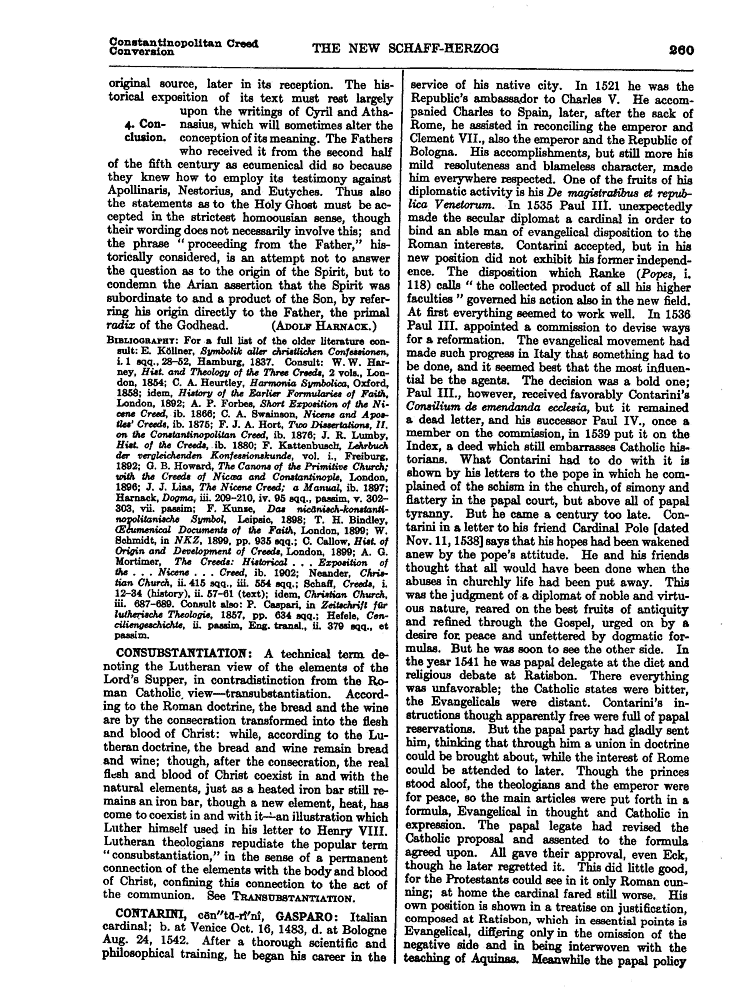
[147] “Gasparo Contarini,” Wikipedia, Jan. 22, 2026, <https://en.wikipedia.org/wiki/Gasparo_Contarini>.
[148] Materially, the Tanakh is nearly identical with the Christian “Old Testament.” However, the collection of books is frequently alternatively ordered; crucial passages are often differently translated; and, overall, its interpretation and significance are dissimilarly construed.
[149] Christopher M. Bellitto, “Language, Leadership, and Locations of Church Reform in the Libellus ad Leonem Decimum,” Thomas M. Izbicki, Jason Aleksander, and Donald Duclow, eds., Nicholas of Cusa and Times of Transition: Essays in Honor of Gerald Christianson, chapt. 10, series Studies in the History of Christian Traditions, vol. 188, Leiden: Brill, 2018, pp. 145-146; <https://brill.com/display/book/edcoll/9789004382411/BP000011.xml> and <https://doi.org/10.1163/9789004382411_011>.
[150] Congregatio Eremitarum Camaldulensium Montis Coronæ.
[151] Gian Benedetto Mittarelli (sometimes written “J. B. Mittarelli,” sic) and Anselmo Costadoni, eds., Annales Camaldulenses (9 vols.), vol. IX, Venice: San Michele in Isola, 1755-1773, pp. 612-719.
[152] By the way, the Basques have long attracted speculation due to their non‑Indo‑European language, unusually ancient — and anomalous — genetic profile, and deep-rooted mountain isolation. A few writers opine that the Basque people may be survivors of the destruction of the mythic island-nation of Atlantis. Indeed, many Basques evidently do have genetic profiles that hearken back to the earliest post-Ice-Age populations of Western Europe — and display fewer later blood-admixtures than other groups in the vicinity. Last but not least, between 1609 and 1614, Basque country was the epicenter of what some describe as the largest, most intense “witch trials” in Euro history. Witch hunters collected sensational accounts of diabolism and local legends, most of which official inquisitors ultimately deemed fanciful.
[153] Vermander, ed., loc. cit.
[154] Berenberg, Patrons and Petitioners, op. cit., p. 158. This latter effort followed Pope Sixtus V’s creation of the “Sacred Congregation on Rites” in 1588. “Congregation,” here, refers to a department within the Roman curia that the pope ordered to oversee the Church’s liturgy and the causes of saints. This body effectively standardized liturgical practice across the Catholic world and established — and then regulated — formal processes for “beatification” and “canonization” (i.e., the path to “sainthood”), giving the Vatican centralized control over both.
[155] For the former designation, see Mark Dice, Inside the Illuminati: Evidence, Objectives, and Methods of Operation, San Diego: privately publ.; “The Resistance,” 2014. I accessed excerpts, unfortunately unpaginated, via Google’s book repository at <https://books.google.com/books?id=WKLlBAAAQBAJ>. On the latter phrase, see Jackson, op. cit., p. 37. Cf. Giovanni Augustino “Johnny” Cirucci, known for such works as Illuminati Unmasked: Everything You Need to Know About the ‘New World Order’ …And How We Will Beat It, n.p.: privately publ., 2015 and Eaters of Children: The Pedocracy Exposed: How Access to Power Is Granted Through the Rape, Torture, and Ritualistic Slaughter of the Innocent, n.p.: privately publ., 2017.
[156] See writers like Eric Jon Phelps, Vatican Assassins: The Diabolical History of the Society of Jesus, Tehachapi, Cal.: Halycon Unified Services, 2001.
[157] A lot of this spins out of the anti-Jesuit “Black Legend,” a complex tissue of accusations, conspiracies, and propaganda that painted Spain and the Society of Jesus as corrupt and Machiavellian. Emerging out of the late Renaissance and early Modern periods (16th-18th c.) this tapestry portrays Jesuits as evil agents of the Catholic crown and pope, secretly aiming for global dominion by engaging in financial chicanery, plotting regicide, and so on. You know, like every other power center — then… and now. It was a major contributing factor to the coordinated expulsions of Jesuits from several European nations — and their colonies — which resulted, ultimately, in their (temporary) “suppression” by Pope Clement XIV in 1773. The order was later restored by Pope Pius VII in 1814. Cf. Julián Juderías, La leyenda negra y la verdad histórica (“The Black Legend and Historical Truth”), Madrid:
Tipografía de la Revista de Archivos, Bibliotecas y Museos (“Publication of the Journal of Archives, Libraries, and Museums”), 1914.
[158] Devon Jackson, who picks up all the crumbs, relates that the Jesuits “were accused of plotting to kill William of Orange, Henry III, Henry IV, and Elizabeth I,” op. cit., p. 37.
[159] “Catholick-Christian” [sic], Pyrotechnica Loyolana, Ignatian Fire-Works; Or, The Fiery Jesuits Temper and Behaviour: Being an Historical Compendium of the Rise, Increase, Doctrines, and Deeds of the Jesuits Exposed to Publick View for the Sake of London, London: printed for “G.E.C.T.”, 1667; <https://archive.org/details/bim_early-english-books-1641-1700_pyrotechnica-loyolana-i_1667/>. Whew! They don’t make titles like they used to!
[160] See, e.g., people such as Terry Melanson, author of Perfectibilists: The 18th Century Bavarian Order of the Illuminati, Walterville, Ore.: Trine Day, 2009.
[161] Supposed “Lutheran librarian” and author of The Revolutionary Movement: A Diagnosis of World Disorders, n.p.: privately published, 1933.
[162] 20th-c. American “fundamentalist” cartoonist. Cf. Edmond Paris, The Secret History of the Jesuits, Chino, Cal.: Chick Publ., 1975.
[163] Proprietor of JamesJpn.net.
[164] Phelps maintains the website VaticanAssassins.org and claims to be the “pastor” of a so-called Reformation Bible Puritan Baptist Church (evidently in “rural Pennsylvania”).
[165] W. C. Browlnee, Popery: An Enemy to Civil and Religious Liberty, and Dangerous to our Republic, New York, C. K. Moore, 1839. Brownlee was supposedly a “distant” relation of U.S. President William McKinley, whom we have discussed elsewhere.
[166] L. H. Lehmann, Behind the Dictators: A Factual Analysis of the Relationship Between Nazi-Fascism and Roman Catholicism, 3rd printing, New York: Agora Publ. Co., 1945 (original 1942).
[167] Martin, The Jesuits: The Society of Jesus and the Betrayal of the Roman Catholic Church, New York: Linden Press; Simon & Schuster, 1987.
[168] H. H. Norris, The Principles of the Jesuits: Developed in a Collection of Extracts From Their Own Authors, London: J. G. and F. Rivington, 1839.
[169] Cf. “Jesuits (founded in 1540), continuing to the Rosicrucians (1614), then to Freemasonry (1717) and continuing to the Illuminati (1776); and if you keep moving ahead — when you get to more modern times you’ll see organizations…”, Dice, loc. cit. Dice’s date for the “founding” of the Society of Jesus must be qualified. Ignatius of Loyola, Francis Xavier, Peter Faber, and several others took their vows in 1534 in the Montmartre area of Paris in Aug. 15, 1534, thus technically establishing their order. However, it wasn’t until the year 1540 that said order received papal approval when Pope Paul III issued his bull Regimini militantis ecclesiæ (“Be Governed by the Church Militant”). This time difference is typical. E.g., the Franciscans and Dominicans were founded — in the sense of being initially formed or gathered together — Febr. 24, 1209 and Dec. 27, 1206 (when St. Dominic de Guzmán created a cloister of nuns — with a group for men in 1215), respectively. However, they were approved (or “confirmed”) by Pope Honorius III in his papal bulls Regula Bullatta (“Sealed Rule,” Nov. 29, 1223, for the Franciscans) and Religiosam vitam (“Religious Life,” Dec. 22, 1216, for the Dominicans). One confusion is that the relevant papal bulls are sometimes described as the legal instruments through which the named orders were “founded.” To complicate matters further, Second Council of Lyon (1274) is also sometimes said to have “approved” the Franciscans (Order of Friars Minor) and Dominicans (Order of Preachers). To my knowledge, no subsequent council “approved” the Jesuits. However, as mentioned in the main text, the Council of Trent certainly gave them both legitimacy as well as a platform for the anti-Protestant program. Of definite SynchroMystical interest is the fact that Montmartre would later become ground zero for the fin-de-siècle French “bohemian” art movement, or La Belle Époque (“Era of Beauty”), that formed the setting for the Australian film director Bazmark Anthony “Baz” Luhrmann’s 2001 movie, Moulin Rouge!
[170] James Japan, “The True Authors of Communism & Socialism: The Jesuits,” JamesJpn.net, Jun. 19, 2020, <https://jamesjpn.net/government/the-authors-of-communism-socialism-jesuits/>.
[171] Though, this identification was made “incorrectly”, according to the source’s author, Paul R. O’Neill and Paul K. Williams; see their Georgetown University: The College History Series, Charleston, S.C.: Arcadia Publ., 2003, p. 76; archived online at <https://books.google.co.in/books?id=peQeOeO39JMC>. Other “Jebbies” who were pretty obviously anti-communist include John LaFarge, Jr., a theological adviser to Pope Pius XI (born Ambrogio Damiano Achille Ratti), and 26th Jesuit superior general, Włodzimierz Halka Ledóchowski. See Beth Ann Griech-Polelle, “Jesuits and Communism: Introduction,” Journal of Jesuit Studies, vol. 5, Dec. 21, 2018, pp. 1-8; <https://brill.com/view/journals/jjs/5/1/article-p1_1.xml>.
[172] Born Rudolf Maximilian Höll.
[173] “Hell Q Crater,” NASA, May 29, 2018, <https://science.nasa.gov/resource/hell-q-crater/>.
[174] Nesta Helen Webster, Secret Societies and Subversive Movements, 2nd ed., London: Boswell Printing and Publ. Co. Ltd., 1924, p. 234; facsimile reprint ed., archived online at: <https://dn710200.ca.archive.org/0/items/secret-societies-and-subversive-movements-nesta-helen-webster_202304/Secret_Societies_and_Subversive_Movement.pdf>. Webster identified other alleged attendees, including a “cabalist” whom she merely names “Duchanteau” and the Marquis François Chefdebien d’Armissan, a supposed Knight of Malta also affiliated with l’Ordre des Frères Africains (the “Order of the African Brothers,” a.k.a. The “African Architect Rite”), Le Rite Primitif de Narbonne (“The Primitive Rite of Narbonne”), and l’Rite Primitif des Philadelphes (the “Primitive Rite of the Philadelphians”) — the latter being associated with the Masonic Rite des Philalèthes (“Rite of the Philalethes,” or “seekers of truth”) of the Marquis Charles-Pierre-Paul Savalette de Langes, who also showed up with Cagliostro, Mesmer, et al. Quite a collection of characters. Cf. Walter Kelly “W. K.” Firminger, “The Romances of [John] Robison and [l’Abbé Augustin] Barruel,” Mar. 5, 1937; in Col. [Francis Martyn?] “F. M.” Rickard, ed., Ars Quatuor Coronatorum (Being the Transactions of the Quatuor Coronati Lodge No. 2076, London), vol. 1, London: W. J. Parrett, 1940, p. 47; archived online at <https://www.quatuorcoronati.com/wp-content/uploads/2021/01/AQC-50-1937.pdf>.
[175] Robert Doyle, Janet Cave, Roberta Conlan, and Esther Ferrington, ed., Mysteries of the Unknown: The Mystical Year, Richmond, Va.: Time-Life Books, 1992, p. 33.
[176] Or, the “Secret Instructions of the Society of Jesus.”
[177] Cf. John Gerard, “Monita Secreta,” Catholic Encyclopedia, vol. 10, New York: Robert Appleton Co., 1911; online at: <https://www.newadvent.org/cathen/10487a.htm>.
[178] The English title of the work referenced here stems from the 1549 translation of John Ponet (Poynet).
[179] One may wish that our list would have been subdivided into “conservative,” “liberal,” or “traditional” categories. However, for reasons that we have already sketched (see the main-text footnote having to do with sidelined theological subtleties), we will leave that exercise for readers.
[180] We shouldn’t even try to enumerate these. But a few honorable mentions might be the following. Hugo Maria Kellner: A Dogmatic Analysis of the Opening Address of Pope John XXIII to Vatican II as a Means of Achieving Doctrinal Unity With Protestantism, N.p.: privately publ., ca. 1964; Articles on Recent Developments in the Catholic Church: Dealing Especially With Bishop Fulton J. Sheen and With the Catholic Traditionalist Movement, N.p.: privately publ., ca. 1980. Georges de Nantes, Liber accusationis in Paulum sextum: À notre Saint Père le Pape Paul VI par la grâce de Dieu et la loi de l’Eglise juge souverain de tous les fidèles du Christ plainte pour hérésie, schisme et scandale au sujet de notre frère dans la foi, le Pape Paul VI (“The book of accusation against Paul VI: To our Holy Father Pope Paul VI, by the grace of God and the law of the Church, sovereign judge of all the faithful of Christ, a complaint for heresy, schism, and scandal concerning our brother in the faith, Pope Paul VI”), Saint-Parres-lès-Vaudes, Grand Est, France: La Contre-Réforme Catholique, 1974. William “W. F.” Strojie (all works privately publ. Out of Sheridan, Ore.): From Rome to Ecône: Vatican II Disaster, 1977; A Short Dictionary of Vatican II Words and Phrases: With Quotations From Pope Pius X on the Errors of the Modernists, 1978; Last days of the Catholic Church, 1979; and Letters on Pope Wojtyla: Fourth Pope of the Revolution, 1980.
[181] Anthony Cekada, Work of Human Hands: A Theological Critique of the Mass of Paul VI, West Chester, Ohio: SGG Resources, 2015. “SGG Resources” is presumably a reference to a printing or publishing arm of St. Gertrude the Great Catholic Church in West Chester, Ohio, at which Fr. Cekada was an assistant pastor (from 1989 to until his death in 2020). He also taught at the affiliated Most Holy Trinity Seminary.
[182] Cambridge, Mass.: Harvard Univ. Press, 1999.
[183] Michael Davies’s three-part series began with: Cranmer’s Godly Order: Liturgical Revolution — Vol. 1, Devon, U.K.: Augustine Publ. Co., 1976; it continues with the following, second installment: Pope John’s Council: Liturgical Revolution — Vol. 2, Devon, U.K.: Augustine Publ. Co.; New Rochelle, N.Y.: Arlington House, 1977; and concluded with the third: Pope Paul’s New Mass: Liturgical Revolution — Vol. 3, Devon, U.K.: Augustine Publ. Co.; Dickinson, Tex.: Angelus Press, 1980. Cf. Michael Davies, Liturgical Time Bombs in Vatican II: The Destruction of Catholic Faith Through Changes in Catholic Worship, Rockford, Ill.: Tan Books & Publ., 2003. In 2008, TAN Books was relocated to Charlotte, N.C. after it was bought out by Saint Benedict Press. Angelus Press names “Fr. Carl Pulvermacher” as its founder, on whom, search the Timeline.
[184] Craig Heimbichner, Blood on the Altar: The Secret History of the World’s Most Dangerous Secret Society, Coeur d’Alene, Idaho: Independent History and Research, 2006.
[185] Coeur d’Alene, Id.: Independent History and Research, 2017.
[186] A theme that Hoffman previously pursued, in great detail, for his earlier Usury in Christendom, the Mortal Sin That Was and Now Is Not: A Study of the Rise of the Money Power in the West, Coeur d’Alene, Id.: Independent History and Research, 2013.
[187] Walterville, Ore.: Trine Day, 2005.
[189] More Catholic Than the Pope: An Inside Look at Extreme Traditionalism, Huntington, Ind.: Our Sunday Visitor Publ., 2004.
[190] Kit Marlowe, Junior, ed., and Jack Eckstein, research dir., Antizion [II], worldwide: Publ. of the Council on Israeli and Jewish Hate Crimes, 2016.
[191] Bill Grimstad, The Jews on Trial: Testimony of 330 Historic Figures on Jewry, Washington, D.C.: privately printed, 1973; William N. Grimstad, Antizion: A Survey of Commentary on Organized Jewry by [575] Leading Personalities Through the Ages, 2nd rev. ed., Torrance, Calif.: Noontide Press, 1976; and William N. Grimstad, Antizion: A Survey of Commentary on Organized Jewry by Leading Personalities Through the Ages, 3rd printing (of the 2nd, rev. ed.), Torrance, Calif.: Noontide Press, 1985.
[192] Taylor Marshall, Infiltration: The Plot to Destroy the Church from Within, Nashua, N.H.: Sophia Inst. Press, 2019. Cf. Bishop Athanasius Schneider, Flee from Heresy: A Catholic Guide to Ancient and Modern Errors, Nashua, N.H.: Sophia Inst. Press: 2024. (On the different sorts of heresy, and on the difficulties in numbering “dogmas,” see the footnotes to 1973 in the Timeline.)